SCAA Specialty Coffee Green and Roasted Bean Grading: From Defects to the 80-Point Specialty Standard
Introduction: The specialty bean grading system used by the Specialty Coffee Association of America (SCAA) and the Coffee Quality Institute (CQI) is an important quality reference in international coffee trade. This article takes an in-depth look at the specialty-grade certification standards for green beans and roasted beans, including defect categories, sampling specifications, and cupping requirements, helping coffee professionals and enthusiasts master the key quality control points from cultivation to roasting and understand why 80 points is the dividing line for specialty coffee.
The quality grading system for specialty coffee directly affects the final flavor performance and market value of coffee. The grading standards established by the Specialty Coffee Association of America (SCAA) have now been adopted by the globally authoritative Coffee Quality Institute (CQI) and have become the internationally recognized basis for specialty coffee certification. Through strict green bean screening and roasted bean evaluation, this system ensures that every specialty coffee bean reaches outstanding quality.
In the green bean grading stage, a 350-gram sample must first be taken precisely; this weight has been scientifically verified as able to represent the quality characteristics of the entire batch. The moisture content of the sample must be strictly controlled between 10% and 12%, which is a key parameter for ensuring the stability and flavor development of coffee beans. Of particular note, green beans must absolutely not carry any objectionable off-odor, including fermented notes, musty notes, or other abnormal smells.
The size uniformity of green beans is another important indicator: the deviation rate from the target size must not exceed 5% of the size specified in the contract. This consistency requirement ensures even heating during roasting and stable final flavor performance. The evaluation of defective beans is divided into two strict levels: Category 1 defects and Category 2 defects, which differ significantly in their degree of impact on coffee flavor.
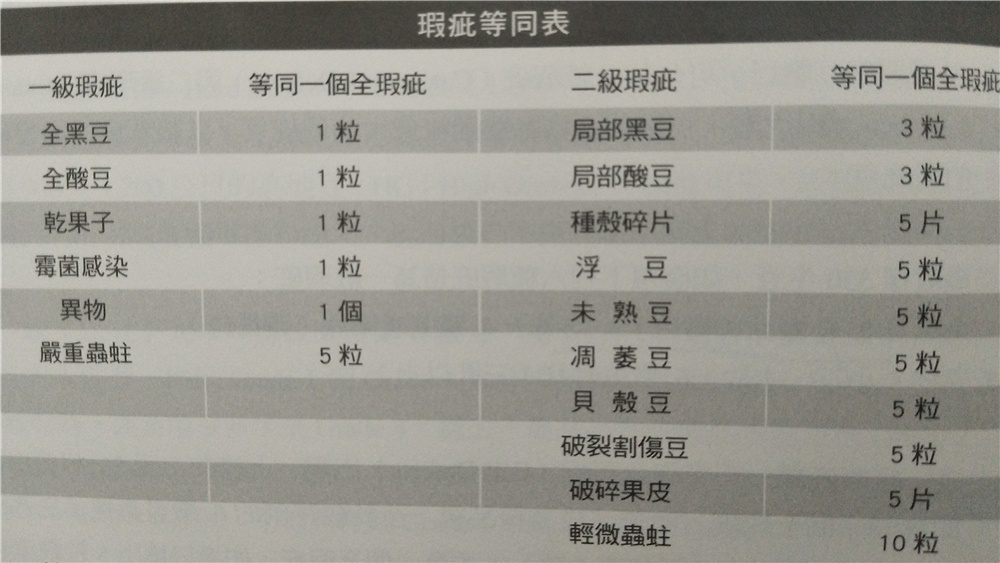
Category 1 defects include six types of defects that seriously affect flavor: full black beans, full sour beans (brown), dried cherries, mold-infected beans (yellow-brown spots), foreign matter (such as small stones and wood chips), and severe insect damage (three or more holes). The first five categories are extremely strict: the presence of even one bean counts as one full defect and directly causes the coffee to lose specialty-grade qualification. The only exception is severely insect-damaged beans, of which up to 5 are allowed without being counted as a full defect, but exceeding this number will downgrade the coffee.
Category 2 defects include ten types of defects with relatively smaller impact: partial black beans, partial sour beans, husks, floating beans, immature beans, withered beans, shell beans, broken/cut beans, broken parchment, and slight insect damage (fewer than three holes). The criteria for this category are relatively lenient: 3 partial black beans or partial sour beans count as one full defect; 5 beans from husks through broken parchment count as one full defect; and slight insect damage requires 10 beans to constitute one full defect. Notably, Category 2 defects allow up to 5 full defects to be present; only exceeding this number will cause downgrading.
The specialty-grade certification standards for roasted beans are equally strict. First, a 100-gram roasted bean sample is taken; this smaller sample size is sufficient to evaluate overall post-roast quality. The most basic requirement is that it must not contain any immature white beans, which usually have flat flavor or even undesirable mouthfeel. Each batch sample must be evaluated by certified professional cuppers, who score comprehensively across four dimensions: dry aroma, wet aroma, flavor, and mouthfeel; the total score must reach 80 points or above to obtain specialty-grade certification.
Even if the cupping score exceeds 80 points, if one full defect in the Category 1 defect class, or five full defects in the Category 2 defect class, is detected at the green bean stage, specialty-grade certification still cannot be obtained. This shows that quality control at the green bean stage is crucial, and defects at any stage can undo all previous efforts. This multi-layered grading system ensures that every cup of specialty coffee tasted by the final consumer represents the highest level of coffee cultivation, processing, and roasting.