Bourbon Coffee Beans: From Origin to Colors and Flavor Guide
Introduction: Bourbon coffee beans, a classic variety in the Arabica family, are favored by coffee lovers and professionals alike for their rich flavor layers and diverse color variations. This article explores the origins and global spread of Bourbon coffee, details the characteristics and flavor differences of red, yellow, orange, and pink Bourbon, and analyzes its market price and cultivation traits to help you fully understand this classic coffee variety.
In the world of specialty coffee, Bourbon coffee beans draw attention for their elegant flavors and diverse fruit colors. Beyond the most commonly heard red Bourbon, there are also yellow Bourbon, orange Bourbon, and the rarer pink Bourbon. These differently colored Bourbons not only offer visual novelty but also each have distinctive flavor profiles.
Bourbon was originally a natural mutation of Typica, and both are among the oldest existing coffee varieties, important branches of the Arabica species. The origin of Bourbon can be traced to Yemen, and it later spread around the world through colonization and trade, especially to the island of Bourbon (now Réunion). The variety was named after its first cultivation on Bourbon Island, and it has thus become one of the core varieties in many of the world's specialty coffee regions.

The global spread of Bourbon coffee is closely tied to French colonial history. In the late 17th century, the French established Bourbon Island (now Réunion) in the Indian Ocean off southeastern Africa, and in the early 18th century they made several attempts to introduce coffee cultivation from Yemen. Historical records show that the French introduced coffee from Yemen three times—in 1708, 1715, and 1718—and finally succeeded in planting and cultivating the distinctive Bourbon coffee on the island. This also made the island an important breeding base for Bourbon in the 18th century.
It was not until the mid-19th century that Bourbon coffee spread from Bourbon Island to Africa and South America. Around 1860, the variety was introduced to the Campinas region of Brazil, gradually replacing Typica, which had lower yields and was susceptible to disease, and became one of the main varieties in Brazilian coffee cultivation. Bourbon then spread further from Brazil to other countries in Central and South America, such as Guatemala, El Salvador, Costa Rica, and Peru, and remains a common variety in many specialty coffee regions today.
At the same time, missionaries promoting coffee in Africa brought Bourbon to Tanzania and Kenya. From 1862 onward, French missionaries established mission stations in several parts of East Africa and planted the Bourbon coffee seeds they brought in local parishes, laying the foundation for Bourbon cultivation in Africa. To this day, under these regions' special microclimates, Bourbon still displays distinctive regional flavors.

Over time, Bourbon coffee underwent multiple natural mutations during cultivation in Brazil and elsewhere, forming varieties with various color variations, most notably red Bourbon, yellow Bourbon, orange Bourbon, and pink Bourbon. These mutations not only changed the color of the coffee fruit but also influenced flavor characteristics and cultivation performance to some extent.
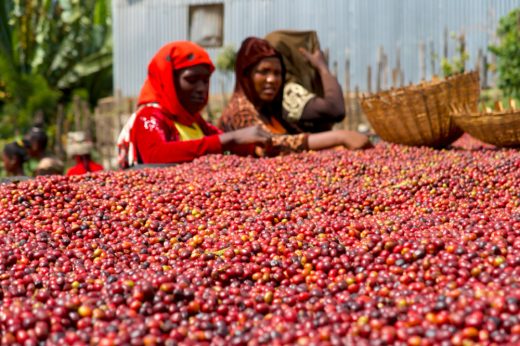
Red Bourbon is one of the most common Bourbon variants; its fruit gradually turns from green to red, finally appearing deep red or dark red. Because red Bourbon is usually grown at higher elevations, its flavor tends to be brighter, with clear acidity, wine-like complexity and sweetness, and rich aroma, making it a favorite among many coffee lovers.Red Bourbon's flavor often features layers of caramel, nuts, citrus, and chocolate, suiting those who prefer a balanced cup.
Yellow Bourbon is a relatively rare mutation, first discovered in Brazil and mainly concentrated in São Paulo state. Its fruit does not turn red when ripe but takes on a distinctive orange-yellow, hence the name. Yellow Bourbon usually has more pronounced sweetness, with clear citrus acidity and tropical fruit aromas, and a fresh, clean flavor. However, because the variety has lower yields and weaker disease resistance, its cultivation is relatively limited.Yellow Bourbon's sweetness and balance make it a preferred choice for those seeking fruity and sweet flavors.

Orange Bourbon is a rarer color variant of Bourbon, first discovered in El Salvador. Its fruit turns orange when ripe, and its flavor often features brighter floral notes and soft acidity, making it a type with a highly individual flavor profile.
Pink Bourbon is an even rarer variety; its cherry fruit is usually pale pink or peach-pink, hence the name. Pink Bourbon is a cross between red Bourbon and yellow Bourbon, but maintaining stable pink fruit is extremely challenging, because fruit color is heavily influenced by recessive genes in the pollen, and color variations may occur during cultivation. Currently, the variety is mainly grown in Colombia and Guatemala, and its unique appearance and flavor have made it popular with many specialty coffee farms.
Beyond the main color variants above, there are some rarer Bourbon mutations, such as Striped Bourbon. This Bourbon looks similar to ordinary red Bourbon, but when the fruit ripens, yellow stripes appear on the surface, hence the name. Striped Bourbon also originates from Colombia and is said to be the result of natural mutation; it has a later ripening period and relatively low yields, but its flavor retains the classic citrus and sweet notes of Bourbon, especially in light roasts, where it can display berry and brown sugar aromas.

In terms of flavor, Bourbon coffee usually has a complex acidity structure and a well-balanced sweetness. Bourbon from different regions presents its own unique flavor profile due to differences in climate, soil, and processing methods. For example, high-altitude Bourbon often has bright acidity with floral and citrus notes, while Bourbon from lower altitudes or warmer regions may show more nutty, caramel, and chocolate flavors.
Overall, Bourbon coffee is a classic variety that combines historical depth with flavor expression. Whether it is the sweet balance of red Bourbon, the fruity abundance of yellow Bourbon, or the rarity and uniqueness of pink Bourbon, they can bring coffee lovers a rich tasting experience. If you are a beginner just starting to explore the world of specialty coffee, you might start with a classic red Bourbon and experience its rounded sweetness and multi-layered aroma; if you prefer fresh fruit acidity and bright notes, yellow Bourbon or orange Bourbon are also worth trying.