Starbucks French Press Guide: Extraction Time, Bean Pairing, and Flavor Tips
Introduction: The French press is a classic tool for home coffee brewing; it is simple to operate yet can present the rich layers of coffee. This article explains in detail the correct way to use a Starbucks French press, covering matching parameters for coffee beans of different roast levels, precise extraction time control, and key techniques for enhancing flavor. Through scientific ratio adjustment and a brewing process, even beginners can easily brew a mellow, balanced cup at pour-over level.
Thanks to its simple operation and excellent ability to retain flavor, the French press has become a popular choice for making coffee at home. Whether it is the bright fruit acidity of a light roast or the rich caramel aroma of a dark roast, this metal-filter device can fully present the coffee's original characteristics. Compared with pour-over or drip equipment, the French press is more forgiving of grind size and water temperature, making it especially suitable for coffee lovers who seek convenience without compromising quality.
In terms of extraction parameters, a medium-fine grind (similar to granulated sugar) is the golden standard. Light-roast coffee is recommended to extract for 4 minutes with a water temperature of 88-92°C; medium roast is optimized to 3 minutes with 90-94°C; dark roast is shortened to 2 minutes, and the water temperature can be raised to 94-96°C. If adjusted to a finer grind, reduce by 1 minute accordingly; with a coarse grind, extend by 1 minute. This flexible range far exceeds that of other brewing methods.
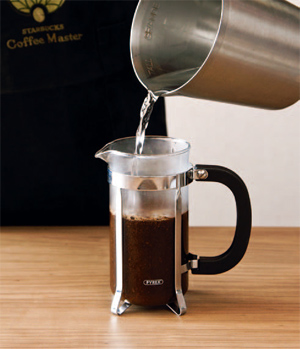
The specific operation process contains many detailed points: in the first step, grinding, it is recommended to use a conical burr grinder adjusted to the medium-fine setting; grinding manually for about 10-12 seconds can achieve the ideal particle size. Preheating must not be overlooked—first rinse the press body and drinking cups with hot water; this both maintains the optimal temperature and avoids loss of flavor. For the pouring stage, a center-outward pouring method is recommended, with the water temperature controlled at the point just after vigorous boiling has stopped (about 93°C), poured in two stages to ensure even extraction.
The standing stage is the key window for flavor development. After putting on the lid, keep the coffee grounds layer still for 4 minutes, and avoid shaking the container during this period. Professionals recommend using a stainless steel filter French press; its heat retention is better than glass and it does not produce off-flavors. The pressing process requires a vertical, steady press, controlling the force within the 2-3 kg pressure range; pressing too fast may cause fine particles to pass through and affect the mouthfeel.
Regarding coffee bean selection, medium-roast Latin American varieties (such as Colombia and Brazil) usually show the French press at its best; their balanced acidity-to-bitterness ratio and full body complement each other. Light-roast African beans (Ethiopia, Kenya) suit users seeking floral and fruity notes, while dark-roast Indonesian beans can strengthen caramel and chocolate flavors. It is recommended to maintain a coffee-to-water ratio between 1:15 and 1:17, that is, every 15 grams of coffee grounds corresponds to 225-255 milliliters of water.
The flavor tasting stage deserves special attention. Before drinking, rinse your mouth with water to reset the palate, and use the "three-stage experience method" to deeply sense the coffee's characteristics: first capture the nutty/fruity/spice aromas in the dry and wet fragrance; then note the brightness of acidity and layers of sweetness on entry; finally, experience how long the finish lingers at the back of the tongue after swallowing. Freshly roasted coffee beans (7-21 days after roasting) can present the fullest flavor expression.
Cleaning and maintenance are equally important. After each use, immediately remove and wash the filter to avoid oxidation of residual coffee grounds affecting subsequent brewing. Periodically soak in a baking soda solution to remove accumulated oils; the glass carafe can be wiped with a soft cloth and warm water. Keep the press dry during storage, and apply a small amount of cooking oil to metal parts to prevent rust. After mastering these techniques, a French press can fully present coffee quality on par with professional pour-over equipment.