Yunnan vs. Brazil Coffee: Flavor Differences and Blending Guide
Introduction: This article takes an in-depth look at the core flavor characteristics of Yunnan coffee and Brazilian coffee, analyzing their essential differences across multiple dimensions, from growing environment and variety characteristics to brewing performance. It also draws on baristas' practical experience to answer in detail the question of whether Yunnan coffee beans are suitable as a blending ingredient, and provides key reference indicators for selecting beans for blends, helping enthusiasts choose coffee beans more scientifically.
When it comes to China's coffee-producing regions, the Menglian and Baoshan areas of Yunnan are an important origin that cannot be ignored. Although this region is known for Pu'er tea, it was only in the late 1990s that commercial-grade coffee beans began to be produced on a large scale. After decades of improvements in cultivation techniques and processing methods, the coffee produced in Yunnan today has gained broad recognition in the international coffee market, and the beans nurtured by its unique terroir often deliver unexpected tasting experiences.
Typical Yunnan coffee, under a medium roast, shows a distinct caramelized sweetness accompanied by a syrupy, full-bodied texture. When extracted by pour-over or drip methods, you can clearly perceive a bright, slight acidity and a lingering cherry finish; this balance makes it a promising candidate for espresso blends. Of particular note is its uniform bean size and dense structure, which provide a good foundation for subsequent roasting.
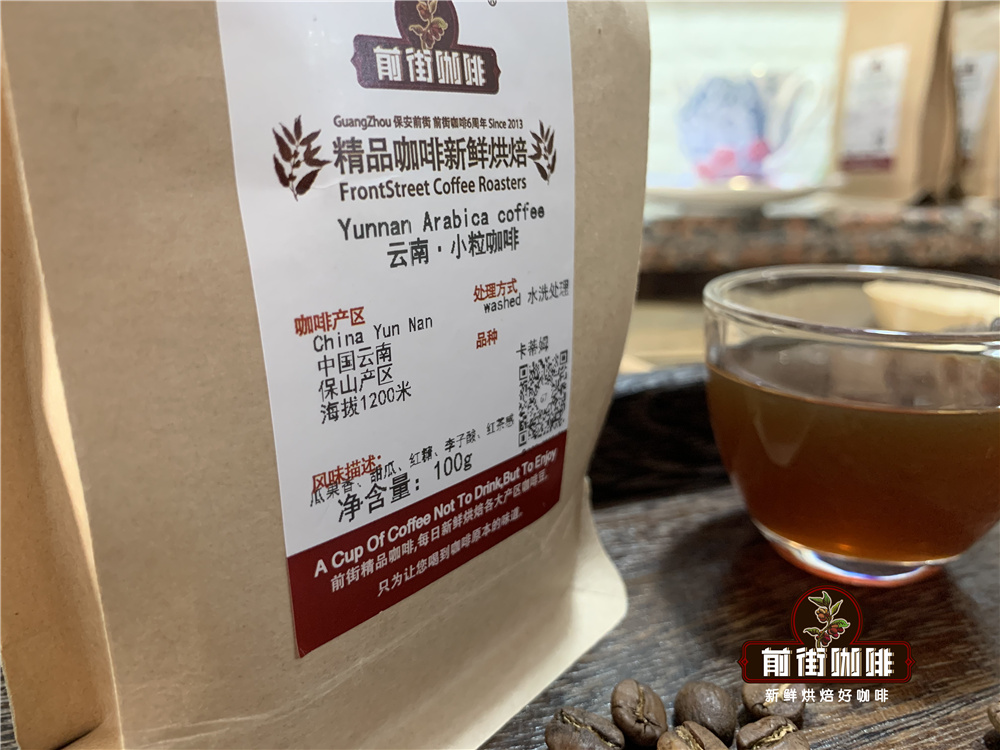
The Catimor variety, widely planted in Yunnan, was created in a Portuguese laboratory in 1959. Researchers crossed the Timor hybrid (which carries Robusta leaf rust resistance genes) with Caturra, successfully developing a new variety combining high yield, disease resistance, and suitability for dense planting. This variety performs best at altitudes between 700 and 1,000 meters—too high and the flavor tends to be thin, too low and the fineness of acidity may suffer. Although it was only introduced to Brazil in the 1970s, its stable productivity quickly made it an important cultivated variety in major Latin American producing regions.
Looking at the flavor spectrum, Yunnan and Brazilian coffees have a natural connection. Both inherit genetic traits from the Timor variety: Brazilian beans are known for low acidity, highlighting nutty notes, balanced body, and moderate body; Yunnan beans build on this with richer layers, possessing both a deep, dark-chocolate-like foundation and a fresh citrus finish. This complementarity is the technical basis for many professional blending formulas that combine the two.
As for whether Yunnan beans are suitable for blending, two aspects need to be considered: first, as a base bean, their stable, full-bodied base can effectively balance the sharpness of high-acidity varieties; second, as a flavor-enhancing bean, their unique fruity notes can add highlights to the overall blend. However, care should be taken to avoid directly mixing them with varieties that have extremely strong acidity or overly prominent floral and fruity notes; small-batch testing is recommended to determine the optimal ratio.
In actual blending practice, it is advisable to pay attention to the following parameters: for Brazilian beans, choose Yellow Bourbon or Mundo Novo varieties (medium-dark roast) to provide a nutty and chocolate base; for Yunnan beans, select mid-to-late harvest lots of Catimor (medium roast) to enhance sweetness and body. When the two are mixed at a ratio of 6:4 to 7:3, the result is usually a well-rounded expression that balances smoothness and complexity.
For home brewing enthusiasts who want to experience the unique charm of Yunnan coffee, the following parameters are recommended: when using a V60 dripper, use a coffee-to-water ratio of 1:15, a water temperature of 90-92°C, and pour in stages using a central spiral plus gentle agitation at the edges. This method fully brings out its full body and distinctly layered sweet-acid transition, and is especially suitable for highlighting caramel flavors when paired with milk to make a latte.