Panama Butterfly Coffee Beans: Terroir and Pour-Over Guide

Introduction: Delve into Butterfly, a mixed-variety coffee bean from the highlands of Boquete, Panama, and see how its 40% Geisha heritage and distinctive processing create layered flavors. From volcanic soil and microclimates to a medium-light roast extraction plan, this guide offers professional-grade flavor descriptions and home brewing parameters to help you unlock this high-value specialty bean's honey pomelo acidity and black tea finish.

As a jewel on the Central American coffee map, Panama's unique geographical barriers and volcanic soils have nurtured a specialty coffee region that draws global attention. Among them, the town of Boquete sits beside Baru Volcano; at elevations above 6,500 feet, the meeting of cool and warm air forms a microclimate belt. This is not only the birthplace of the legendary Hacienda La Esmeralda Geisha but also the home of Butterfly coffee beans, which combine quality with an approachable price.

The Boquete region's core competitiveness comes from three natural gifts: basalt soils formed by volcanic eruptions and rich in iron and magnesium minerals, a humid environment with annual rainfall of 3,000 mm, and a three-dimensional climate with day-night temperature swings of more than 10°C. Together these conditions allow coffee cherries to slowly accumulate sugars while retaining a bright acidity base. Notably, the area contains multiple microclimates; differences in soil pH and sunlight hours from plot to plot mean even neighboring estates can produce beans with very different flavors.

Butterfly coffee beans' uniqueness first shows in their variety composition—70% Geisha genetics blended with Caturra and Catuai, with Geisha accounting for about 40%. This mixed-variety model stems from early estates' co-cultivation strategy to raise yields, which unexpectedly created a flavor-stacking effect. Grown at 1,600 meters on volcanic slopes, together with the local combined honey and washed processing, the beans retain the jasmine aroma that is Geisha's signature while integrating the full-bodied texture of the Caturra variety.
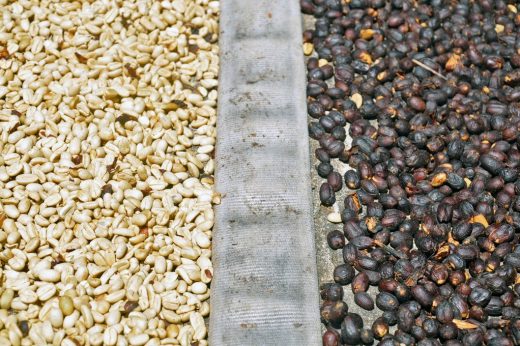
In processing, the carefully selected washed method is especially key: after harvest, coffee cherries are floated to remove unripe fruit, the mucilage is separated with a pulper, and the beans are placed in fermentation tanks held at a constant 28°C to break down the mucilage. Professional tip: fermentation time must be strictly controlled at 18-24 hours; too long leads to over-fermentation and off-flavors. After washing, the parchment beans are dried on African raised beds for 12-15 days, turned 3-4 times daily to ensure even drying to 11% moisture content.

Cupping data show that this medium-light roasted bean presents a three-stage flavor evolution: the first sip brings the fresh acidity of bergamot and honey pomelo, the middle opens into the sweetness of black tea and caramel, and the finish carries the warm aftertaste of dried white peach and black tea. The dry aroma is dominated by citrus essential oils, while the wet aroma reveals a clear interweaving of honey sweetness and white florals. Professional roasters recommend keeping development time in the 12:00-12:30 range to preserve the bean core's lively acidity.

For home brewing, the classic combination of a V60 dripper + 91°C water is recommended: set grind so 80% passes a No. 20 sieve (about the texture of Chinese-standard fine granulated sugar), use 15 g of coffee to 225 ml total water, a 1:15 ratio. The three-pour plan: first pour 30 g of water and bloom for 30 seconds until an even dome forms; second, pour 95 g in a small stream around the center until the bed drops by half; finally, pour the last 100 g slowly along the dripper's spiral ribs until full. The key technique is to keep the pour height above 15 cm, using the water's impact to help the coffee bed expand fully.

The V60 dripper's patented spiral ribs effectively extend water-coffee contact time to about 2 minutes 30 seconds while avoiding channeling that causes localized over-extraction. Solutions to common problems: if sharp acidity appears, coarsen the grind to 70% passing rate and lower the water temperature to 90°C; if the finish is bitter, shorten extraction time or reduce total dose. Advanced brewers can try pre-infusion: before the main pour, pre-wet the coffee grounds with a small amount of hot water for 30 seconds to improve extraction evenness.

This coffee bean, blending Panama's volcanic terroir with the advantages of mixed varieties, proves that specialty coffee need not be luxurious. Whether you are an explorer chasing Geisha flavor characteristics or a daily drinker focused on value, you can find a balance point here—a bright, lively acidity structure paired with the gentle foundation of black tea and honey, just like the morning mist that lingers year-round over the Panama highlands: fresh yet layered.