Why Salvadoran Coffee Is Exceptional: Volcanic Regions and Classic Varieties
Introduction: As a representative specialty coffee region in Central America, El Salvador produces balanced, high-quality beans thanks to its unique volcanic soil and high-altitude environment. This article takes an in-depth look at the natural factors behind the country's coffee quality, details the geographical features of five core regions, highlights the characteristics of the two main varieties, Bourbon and Pacas, and provides practical application cases of honey and washed processing, helping you fully understand the coffee charm of this small Central American country.

Although El Salvador is one of the smallest countries in Central America, its high population density has given rise to a highly distinctive coffee industry. The country's coffee is known for its balanced and harmonious flavor, with soft acidity, prominent sweetness, and a natural aromatic character. Along with neighboring Costa Rica, it is a birthplace of modern honey processing, and its coffee system sets a benchmark in both quality grading and processing techniques.

The country's coffee cultivation strictly follows an altitude grading system, with high-mountain areas above 1,200 meters producing high-quality beans; for every 300 meters of elevation gain, the coffee grade rises accordingly. The five main regions are concentrated on slopes covered in volcanic ash, and the harvest season runs from October to March each year. To ensure quality, coffee trees are generally grown under shade, using tall canopies to regulate light and temperature. The core varieties are Bourbon and Pacas of the Arabica family, noted for their plump beans and rich flavor layers.

The Santa Ana volcanic region west of the capital is the highest-altitude volcanic activity area (2,381 meters). Although an eruption in 2005 caused losses, the fertile soil formed by volcanic ash continues to provide abundant nutrients. The area's microclimate is complex and moisture-rich, creating coffee with a delicate flavor. Of particular note, the primary forest ecosystem is well protected, and wild birds and reptiles are often seen living alongside the coffee plantations.

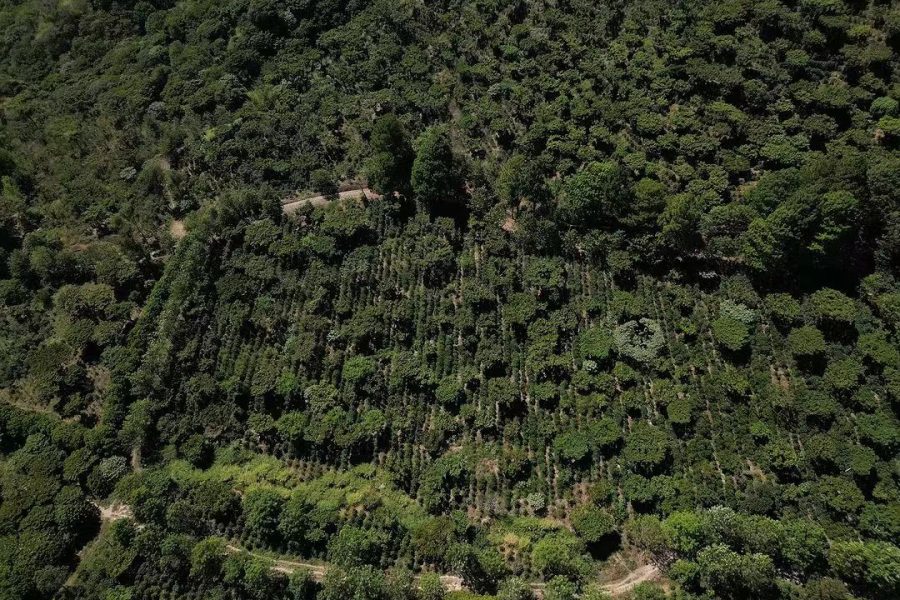
Plantations dominated by the Bourbon variety use jungle-style management, retaining native tree species as natural shade. This ecological approach not only maintains biodiversity but also creates an additional source of income for farmers. Bourbon, a natural mutation of Typica, has bright red ripe cherries, broad leaves, and a relatively high planting density. Although its yield is lower, it has a distinctive red-wine-like aroma and bright acidity.

Local producers innovatively use a hybrid process of 50% honey + 50% washed: the honey stage takes place on drying beds at 800 meters elevation, where strong sunlight accelerates pectin transformation to create a unique sweet aroma; the washed stage relies on abundant water resources to ensure a clean cup. This combined process can present multiple flavor dimensions such as chocolate and stone-fruit cream at the same time, making it particularly suitable for coffee lovers seeking complexity.

Roasting high-density coffee beans requires special attention: extend the dehydration phase over medium heat (an initial drum temperature of 180°C is recommended), and after first crack maintain a drum temperature of around 194°C to develop sweetness. In practice, the caramelization process can be controlled by adjusting the airflow damper (open to 5 after first crack), and the final drop temperature should be kept in the 194–196°C range to highlight body.

For home brewing, a V60 dripper is recommended, with these parameters: 15 g of coffee to 225 ml of water (a 1:15 ratio), 88–90°C water temperature, and a medium-fine grind (80% passing a Chinese standard No. 20 sieve). For staged extraction, first do a 30-second bloom (30 g of water), then pour in a small stream until the scale reads 125 g and pause, and finally continue pouring to 225 g to complete extraction (about 2 minutes total), which fully brings out the balance of a nutty, creamy base and a berry finish.

The country's other important regions are also worth exploring: the western Chaparral volcanic belt is known for its high, bright acidity, while the central Ahuachapán region is known for its full body. Beans from different altitudes (1,200–1,800 meters) perform differently—the Pacas variety at lower altitudes stands out for its sweetness, while Bourbon at higher altitudes develops more complex spicy notes. Understanding these regional differences helps you select beans precisely according to your personal taste preferences.