Panama Volcán vs Boquete Geisha: Natural Process and Terroir
Introduction: As an important producing region for specialty coffee worldwide, Panama's two core regions of Volcán and Boquete, thanks to their unique microclimates and geographic conditions, nurture Geisha coffee beans with distinct flavors. This article analyzes in depth the differences between natural-process Geisha from the two places, from altitude, terroir and processing method to flavor expression, helping coffee enthusiasts and professionals better understand regional characteristics and master the key points of flavor identification and brewing.
Because of its special geographic location, the Panamanian highlands form a one-of-a-kind microclimate. Cold air from the east rises along the Central Cordillera and gathers above 6,500 feet (about 1,980 meters) in the Volcán and Boquete areas, creating a microclimate suitable for specialty coffee. These areas sit around the Barú volcano, and their soils are rich in minerals and organic matter, providing an ideal growing foundation for coffee trees.
When it comes to Panamanian specialty coffee, most people first think of the Boquete region. In recent years, however, the neighboring Volcán region, with its distinctive flavor expression, has gradually emerged in international specialty coffee competitions, even winning the Best of Panama competition several times. Compared with Boquete, Volcán has lower average annual rainfall and lies on the western side of the Barú volcano, which gives its coffee a more intense dried-fruit sweetness and aroma, with relatively milder acidity.
The Volcán region is mainly distributed across highland areas at 2,000-3,000 meters, and is known for a mild, balanced flavor. It is worth noting that even when the same variety (such as Geisha) is planted, differences in altitude significantly affect coffee performance—for example, Geisha grown at 1,400 meters and at 1,900 meters have completely different flavor layers and body. Although neighboring Volcán and Boquete both belong to Panama, because of differences in geographic micro-environments, Boquete coffee usually shows brighter acidity and higher sweetness.
Terroir not only shapes the final flavor of coffee but also imposes specific requirements on growing and processing. Roasters need to adjust roasting curves according to the beans' molecular structure (the potential flavors and aromas influenced by terroir); growers need to adapt to local conditions and optimize planting density, water and fertilizer management, and green bean processing methods. Together these details determine the overall quality of coffee from cultivation to cup.
Take Hacienda Janson in the Volcán region as an example. The estate is located on the western side of the volcano, with average annual rainfall lower than Boquete, and its unique microclimate gives its coffee stronger dried-fruit flavors and prominent sweetness. The estate sits at about 1,700 meters, with soil of nutrient-rich volcanic ash, and planting density is strictly controlled at 2,000 Geisha trees per hectare (about half the usual density) to ensure each coffee tree has ample growing space. The Janson family insists on 100% sustainable farming, and its own processing plant ferments coffee cherries and turns them into organic fertilizer; all green beans carry traceable lot numbers, and their quality consistency is widely recognized.
Hacienda Esmeralda in the Boquete region is one of Panama's oldest and best-known coffee estates, located on the eastern side of the Barú volcano at altitudes of 1,200-2,000 meters. The area includes the ecological conservation zone of Barú Volcano National Park, with rich biodiversity; seven microclimates and year-round mist provide excellent growing conditions for coffee. Through years of experimentation, the estate found that only Geisha beans grown above 1,400 meters can fully express the variety's characteristics, so its Geisha grading is based primarily on growing altitude, supplemented by cupping results, divided into different grades such as Red Label (competition lot) and Green Label (reserve lot).
In picking and processing, the two estates each have their own characteristics. The coffee cherries picked at Hacienda Janson are called "oxblood coffee cherries" and have extremely high sweetness; after fine processing at the dedicated plant, precise roasting enhances their cupping reference value. Hacienda Esmeralda insists on hand-picking ripe fruit and, because of its protection of the natural environment and special care, has obtained Rainforest Alliance certification. Its Red Label Geisha (competition lot) is grown at 1,600-1,800 meters, scores above 90 points in cupping, and comes only from the highest parts of the Jaramillo and Cañas Verdes estates; it has bright floral aromas and citrus notes, and each lot can be traced to the specific picking date and plot information, requiring acquisition through the annual global auction. Green Label Geisha (reserve lot) is a blend of micro-lots from multiple estates, also grown at 1,600-1,800 meters, combining the classic Geisha floral and fruit aromas with citrus acidity; it is thick and juicy on the palate with clear flavor layers.
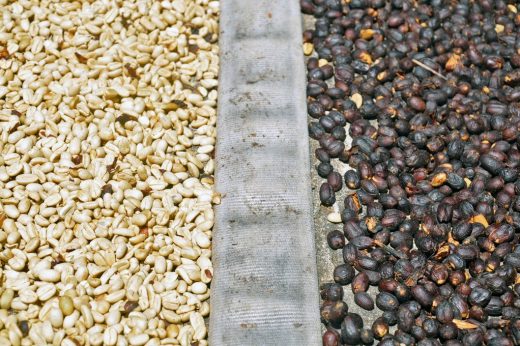
The natural process is a common processing method for Geisha in both regions: ripe picked coffee cherries (full beans that sink to the bottom of the water tank) are spread evenly on drying beds and naturally dried to a moisture content of about 12%, taking 2-4 weeks, and finally the dried hard skin and parchment layer are removed with a huller to obtain green beans. The advantages of this method are low cost and simple operation, and while the green beans dry inside the fruit pulp they fully absorb the essence of the fruit, giving the coffee rich fruit aroma, notable sweetness and a full body.
The flavor characteristics of Panamanian Geisha coffee beans are especially distinctive: prominent floral aromas (such as rose and honeysuckle) and citrus aromas (such as lemon and grapefruit), paired with extremely high cleanliness, soft and elegant acidity and a lasting, creamy sweetness, balanced on the palate like fine black tea. Light roasting preserves these characteristics to the greatest extent, while too dark a roast may cause loss of floral and fruit aromas and acidity (specific adjustments depend on the beans' characteristics).
The natural-process Geisha green beans from Hacienda Janson are a beautiful blue-green, long and slender, with aromas of fresh grass, peach, berries, wine and a faint oolong tea sweetness; on the palate, lemon and citrus are at the core, accompanied by multi-layered sweet-tart notes of fruit wine, apple, rose, dark chocolate, pomegranate, ripe grapes, peach and dark berries. Esmeralda Red Label Geisha has refined, soft acidity on entry, with sweetness that emerges quickly and lingers; the palate is clean and translucent like black tea, with complex aromas of rose, honeysuckle, sweet potato, grapefruit, lemon and cane sugar, and a long finish. Green Label Geisha is more exuberant: on first entry the floral aroma, strawberry fruit and citrus acidity are bright and gentle, and as the temperature changes it reveals jasmine, berries, honeysuckle, fruit candy and oolong tea aromas in turn, with a finish of cantaloupe sweetness and honey aroma, fresh and balanced overall.
For pour-over, a cake cup immersion-style extraction is recommended (to enhance texture and viscosity): 15 grams of coffee, water temperature 91-92°C, grind size BG 5R (64% passing a Chinese standard No. 20 sieve), water-to-coffee ratio 1:15-16. The specific method: bloom with 27 grams of water for 30 seconds, then pour in a clockwise circle centered on the dripper, pausing at 27 grams and waiting 30 seconds; for the first pour, circle slightly slowly (a little faster on the outer ring), stop the flow at about 1:15, and when the liquid level drops by one-third make the second pour (concentrated in the center to avoid channeling), ending extraction at 2:05 (the tail end can be discarded to reduce astringency). For staged pouring, 30-125-230 grams is suggested, balancing flavor extraction and mouthfeel.
In summary, altitude is a key factor affecting coffee flavor—the slower the fruit ripens, the more sugar accumulates, and the greater the flavor complexity and bean density. Besides altitude, the distance of the region from the equator and wind conditions also need to be considered. Even for neighboring Volcán and Boquete estates, their natural-process Geisha show subtle differences in green bean appearance, roasting performance and flavor details. When choosing Geisha, one must combine the specific growing altitude, processing method and flavor preference, and through continuous tuning and cupping, fully bring out the unique potential of each bean.