Pour-Over Three-Pour Method: From Principle to Practice
Introduction: Mastering the three-pour method is a key step in improving pour-over coffee quality. This article takes an in-depth look at the core principles of this mainstream pour-over technique, explains in detail the operational key points and parameter control for each pour, and reveals its influence on the expression of the coffee's front-, middle-, and back-end flavors. Through a professional perspective, it breaks down the underlying logic of blooming and staged pouring, supplemented by practical brewing cases, to help coffee enthusiasts systematically understand how to balance extraction efficiency and flavor layers through precise pouring.
The essence of pour-over coffee is the dynamic interaction between water and coffee grounds, and the three-pour method is a typical approach that achieves precise extraction through staged control of water flow. This technique, which divides the total poured water into three stages, can effectively distinguish the coffee's front-end fresh flavors, mid-section body and mouthfeel, and back-end aftertaste characteristics; it is a core method used daily by many professional baristas.
[Image placeholder:  ]
The so-called three-pour method is essentially staged extraction achieved by changing the amount of water and the strength of the flow in each pour. The conventional procedure is: first, a small flow to activate the coffee bed → second, a medium flow for stable extraction → finally, a large flow to strengthen the release of compounds. This technique places high demands on controlling the pouring rhythm and requires precisely grasping the start timing and stopping water level of each pour; it is usually recommended to begin the next pour when about 1 cm of height remains on the coffee bed surface.

[Image placeholder:  ]
This method adapts broadly to different roast levels, but the pouring strategy must be adjusted for different roast types. For medium-light roasted beans, a progressive flow-increasing pattern of "small–medium–large" is recommended, while dark roasted beans require appropriately lower initial pouring intensity to avoid over-extraction. It is worth noting that this method does not rely on auxiliary means such as stirring or dripping; uniform extraction is achieved through the basic pouring motion alone, which places higher demands on the stability of the coffee equipment.
[Image placeholder:  ]
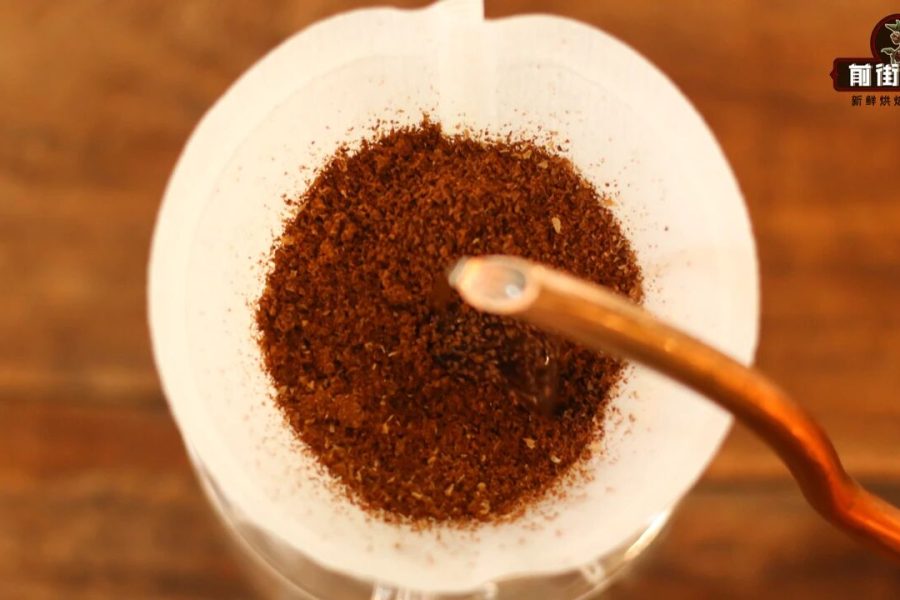
The first pour, the bloom, is the foundational step of the three-pour method; its core role is to release carbon dioxide from inside the coffee grounds and establish an even water-absorption environment. Freshly roasted coffee beans (a resting period of 3–7 days is recommended) will show obvious bubble activity at this stage, and dark roasted beans typically release 30%–40% more gas than light roasted ones. During operation, the surface of the coffee grounds should be leveled to form an even plane, and a fine, dense stream of water (about twice the dose of grounds; a common 30 g dose corresponds to 60 ml of water) should be poured slowly in a circular motion, maintained for 30–40 seconds until an even shrunken texture appears on the surface of the coffee bed.
[Image placeholder:  ][Image placeholder:
 ][Image placeholder:
 ]
Three key parameters must be strictly controlled during the bloom stage: the poured water is recommended at 1.5–2 times the weight of the coffee grounds (adjusted according to freshness); the water temperature must match the roast level (90–93°C for light roast, 86–88°C for dark roast); and the contact time between grounds and water should not exceed 45 seconds. Common mistakes include pouring too forcefully, which causes channeling, or using too little water, which causes uneven local extraction. Professionals recommend using a thermometer to monitor water temperature fluctuations and ensure precision control within ±1°C.
[Image placeholder:  ]
The second pour focuses on extracting mid-section flavors; the key point is to start from the center of the coffee bed and pour in a small circular motion about 2–3 cm in diameter. A slightly larger flow than during the bloom is recommended (about 1.2 times the dose of grounds), stopping when the water reaches two-thirds of the height of the coffee bed. During this stage, the stream must penetrate the bed vertically to avoid flowing along the edge of the dripper and causing over-extraction at the edges. In practice, begin pouring when the water level drops to 1 cm below the top of the coffee bed; the total amount poured in this stage is usually 40%–50% of the total water.
[Image placeholder:  ]
The final pour carries the important task of releasing deep flavor compounds; at this point the pouring range should be expanded to a large circle 5–8 cm in diameter, and the flow speed appropriately increased. It is recommended to begin the third pour when the water level drops to the middle of the coffee bed, promoting the tumbling motion of the coffee grounds at the bottom by increasing the disturbance of the water flow. At this stage, particular care must be taken to avoid excessively long gaps between pours (a single pour interval of no more than 20 seconds is recommended); otherwise, off-flavors will be extracted in the tail end. The total amount poured should be controlled at the final 20%–30% of the total water, and the water level should always be kept above the bottom of the coffee bed.
[Image placeholder:  ]
Taking a typical light-roasted Kenyan bean as an example, a professional brewing plan recommends a V60 dripper with a 1:15 coffee-to-water ratio (e.g., 20 g of grounds to 300 ml of water), with the grind set at 80% passing a No. 20 sieve (equivalent to the coarseness of Chinese standard fine granulated sugar). For the first bloom pour, add 1.5 times the dose of grounds in water (30 g of water) and hold for 30 seconds; for the second pour, pause for 1 minute when the water reaches 125 ml; for the final pour, top up the remaining water and complete all pouring within 2 minutes 30 seconds. This parameter combination effectively highlights bright citrus acidity and berry sweetness while maintaining a clean aftertaste.
[Image placeholder:  ][Image placeholder:
 ][Image placeholder:
 ][Image placeholder:
 ]
In practice, parameters need to be adjusted dynamically according to the characteristics of the coffee beans: for hard beans from high-altitude regions, the bloom time can be appropriately extended to 45 seconds, while for aged beans the water temperature should be lowered by 1–2°C. Solutions to common flavor defects include: if sharp acidity appears, increase the bloom water amount; if the aftertaste is bitter, shorten the final pour time. Remember, a stable technique is more important than precise parameters; it is recommended to develop the ability to sense flow speed and changes in the coffee bed through repeated practice.


