Typica vs. Arabica Coffee Bean Flavor Comparison: A Beginner's Guide to Choosing Beans for Pour-Over

Introduction: A deep dive into the core differences between Typica and Arabica coffee beans, from variety origins to flavor characteristics, guiding you through the key points of selecting specialty coffee beans. Through a multidimensional comparison of variety evolution history, cultivation characteristics, and sensory experience, this article helps you understand the unique expressions of different coffee beans in acidity, sweetness, and body, providing a professional bean-selection reference for home brewing.
The variety differences of coffee beans directly determine the underlying logic of flavor. Among the many heirloom varieties, Arabica occupies the mainstream of the specialty coffee market due to its excellent aroma and mouthfeel, while Typica, as its representative variety closest to the original genes, has always been the focus of discussion among coffee enthusiasts when it comes to flavor. Although both belong to the Arabica family, they show significant differences in cultivation adaptability, chemical composition, and final brewing performance.

From a botanical classification perspective, there are only three native commercial coffee species worldwide: Arabica, Robusta, and Liberica. Among them, Arabica, with 60%-70% of global production, has become the core carrier of the specialty coffee system. This variety originated in the Ethiopian highlands and, after spreading through the Arabian Peninsula, gave rise to numerous variants; Typica is precisely the classic branch that preserves the original genetic characteristics. By contrast, although Robusta is widely used in the instant coffee sector due to its high disease resistance and high yield, its rough mouthfeel and double caffeine content make it difficult to enter the specialty ranks.
As one of the oldest existing cultivated varieties, Typica's history can be traced back to the coffee birthplace at the border of Yemen and Ethiopia. The plant is characterized by a tall tree shape (3-4 meters), bronze-colored leaves, and a distinctive copper-colored terminal bud, with slender oval beans. This variety is extremely demanding regarding its growing environment: it requires high-mountain conditions above 1,200 meters in elevation and lacks resistance to leaf rust, resulting in higher cultivation and management costs. Despite its low yield, its flavor complexity has always been highly praised—a bright lemon-acid base paired with a silky body, with a finish that often carries a clear sugarcane-like sweetness.

Observing Typica's derived mutations allows for a clearer understanding of variety evolution. For example, Hawaii's Criollo and Jamaica Blue Mountain No. 1 both belong to the Typica lineage; these variants have formed unique regional flavor characteristics through geographic isolation. It is worth noting that Typica grown at the Blue Mountain region's 1,310-meter elevation achieves a textbook-level synergy of sweet-acid balance and body. The choice of processing method is equally key: washed processing can reinforce its clear fruity acidity, while natural processing may amplify sweetness and body.

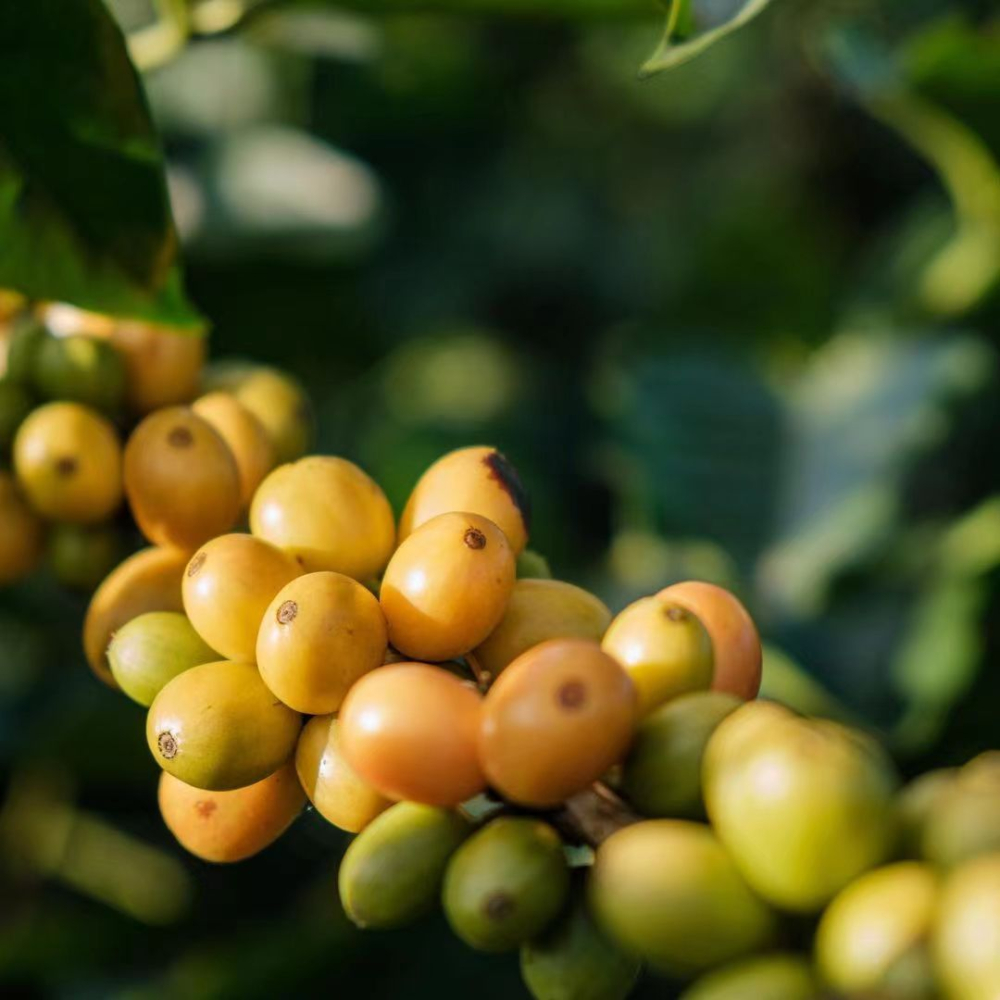
In sharp contrast to Typica is the Bourbon variety. This sister variety, produced by a natural mutation of Typica, has a bean shape that shifts from slender and pointed to plump and round, and its flavor profile also turns toward rounder caramel sweetness and a complex acidity structure. Typical representatives of the Bourbon line include Red Bourbon and Yellow Bourbon; the former is known for high-elevation cultivation (1,100-2,200 meters), while the latter has unique visual recognizability because its fruit is golden yellow. The natural-process Yellow Bourbon from Brazil's Fazenda Rainha demonstrates the typical advantages of this variety: a nutty base overlaid with bright fruit notes, clean acidity, and a refreshing finish.
Caturra and Catuai, which are more common in modern coffee cultivation, reflect the commercial wisdom of variety improvement. Caturra, a dwarf mutation of Bourbon, not only adapts to high-density planting but its plant height of 1.2-1.5 meters also makes manual harvesting easier. Caturra from Colombia's Huila region often presents a combination of berry-like flavors and a chocolate finish, and with every 100-meter increase in elevation, its acidity brightness and aroma complexity improve significantly. Catuai, through hybridization with the Mundo Novo variety, has strengthened fruit attachment, making it particularly suitable for cultivation areas with strong winds.

The differences between Typica and other varieties within the broad Arabica classification show systematic distinctions at the sensory level. Take Geisha, which has attracted much attention recently (actually a Typica variant), as an example: its tree height of up to 1.8 meters and flowering cycle lasting several months create a unique floral-fruity aroma—the honey sweetness of the native variety from Ethiopia's Geisha Mountain, after cultivation at Panama's Hacienda La Esmeralda at 1,600 meters, transforms into a compound aroma of bergamot and white peach. Such varieties usually require more precise extraction parameter control: a water temperature of 92-94°C combined with a medium-fine grind (75%-80% passing a Chinese standard No. 20 sieve) is recommended to fully release their richly layered aromatic compounds.
For home brewers, variety selection directly affects flavor expectations. Typica-line coffees are more suitable for drinkers pursuing fresh acidity and a clean finish; a V60 dripper with a 2:15 coffee-to-water ratio is recommended. Bourbon-derived varieties, meanwhile, can display a fuller body through immersion-style devices such as the French press. Particular attention should be paid to the fact that different varieties differ significantly in their sensitivity to defective beans—Typica, due to its scarce yield, is more likely to have its overall flavor balance affected by a single defective bean, so the hand-sorting stage must be especially strict.

From the perspective of cultivation practice, the adaptability differences between Typica and Arabica variants are directly linked to economic value. Traditional Typica yields less than 1 ton per hectare and requires supporting shade trees and windbreak facilities; the improved Caturra variety, through dwarfing, increases planting density by 30%, and together with disease-resistant improved varieties such as Catimor, enables the Yunnan region to achieve stable output at mid-elevations of 1,200 meters. Innovation in processing methods is equally important: washed processing can highlight a variety's original flavor characteristics, while honey processing or anaerobic fermentation can compensate for certain varieties' shortcomings in sweetness.
Understanding these variety characteristics is not only about appreciating flavor but is also the foundation for improving brewing skills. When using Typica-line coffee for pour-over, it is recommended to extend the bloom time to 45 seconds to awaken dormant aromatic compounds; Bourbon-derived varieties, due to differences in cell wall structure, are better suited to a center-pour technique to avoid over-extraction. As the specialty coffee market becomes more segmented, precisely matching variety characteristics with brewing plans will become an essential skill for professional enthusiasts.