Global Coffee Harvest Seasons and Blend Flavor Analysis: A Guide to Buying Beans for Pour-Over
Introduction: Learn when coffee beans are harvested around the world and master the golden window for enjoying fresh beans. This article breaks down the coffee harvest cycles of different producing regions and explains why certain specialty coffees are only available at specific times each year. It also takes a deeper look at the flavor-blending logic behind coffee blends, helping you understand the mysteries of how coffee flavor changes and enhancing your pour-over tasting experience.
Coffee is one of the world's most popular beverages, yet its raw material—the coffee bean—is actually an agricultural product with a distinct growth cycle. Like many crops, coffee beans show clear regional and seasonal differences in ripening and harvest, and this directly affects when we can taste fresh coffee from different producing regions.
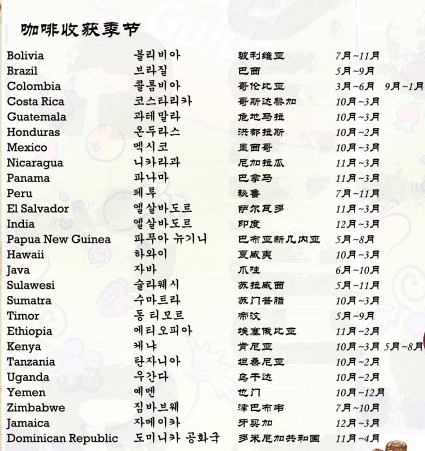
It is worth noting that although the world's major coffee-producing regions are widely distributed, harvest lengths vary from place to place because of differences in climate and geography. Regions near the equator, such as Ecuador, Brazil, Kenya, and Sumatra, benefit from favorable climate conditions and can harvest coffee almost continuously throughout the year. By contrast, the coffee harvest periods in places such as Mexico, Panama, and Ethiopia are much shorter. From picking to final export, coffee beans also go through several weeks of processing, including drying by different methods and a warehouse storage period of 60 to 90 days (this stage mainly serves to remove the parchment layer that protects the beans).
Given that it takes several months for coffee to go from the tree to the consumer, the fresh coffee from different regions we can taste varies by season: in winter, beans from Central Africa (Tanzania, Uganda, Burundi), South America (Colombia, Peru, Ecuador), and Indonesia and Papua New Guinea are the freshest; spring is a good time to taste coffee from Brazil and Mexico; in summer, fresh beans from Central America (El Salvador, Guatemala, Panama) and East Africa (Kenya, Ethiopia) are at their best; and in autumn, beans from Brazil and Yemen take center stage. Note that weather conditions, shipping routes, processing methods, and customs certification can all affect when beans actually arrive—last year, for example, our Colombian coffee was delayed until the end of February for various reasons, whereas in previous years it usually arrived in January.
Another phenomenon worth noting is that the freshness of coffee beans gradually declines with longer storage. To ensure customers can taste coffee at its flavor peak, we limit purchases of seasonal coffees and aim to sell them before the flavor begins to fade.
Even within the same producing region, flavor characteristics vary from year to year because of changes in climate conditions. Natural factors such as the amount of rainfall and fluctuations in temperature all affect bean quality. Although we often buy beans from the same partner farms, each year's harvest, while retaining its original character, always brings some pleasantly surprising subtle variations—and that is part of the pleasure of coffee tasting. For example, the Finca El Socorro coffee we tried for the first time last autumn made a strong impression with its first harvest, and we are now looking forward to its second harvest later this year to see how the coffee from this plot performs after more complete growth.
Since single-origin coffees cannot be supplied consistently year-round, how do the blends we know so well maintain a relatively consistent flavor profile? The secret lies in our blending philosophy—not simply fixing the use of certain specific coffee varieties, but formulating around a target flavor profile. Our baristas build the desired flavor outline based on the quality beans available each season, adjusting the proportions of different beans and even adding or removing the types of coffee used in the blend. As you may have noticed, our signature blend shows slight variations throughout the year, but we are always committed to offering coffee lovers a consistently high-quality choice in terms of flavor.