Yunnan Coffee Explained: From Growing Regions to Specialty Beans, What Makes Dehong's Huaguoshan Coffee Special?
Introduction: Yunnan contributes 99% of China's coffee production, yet it has long faced the difficulties of low planting efficiency and weak brand influence. This article traces the development of Yunnan coffee from its planting history to its core producing regions, focuses on the terroir advantages of high-quality regions such as Dehong, and explores how to enhance value through the specialty coffee path. At the end, it includes the flavor characteristics and buying advice for Yunnan arabica coffee to help you find the beans you like.
In Beijing, Shanghai, Guangzhou and Shenzhen, a casual cup of specialty coffee easily costs thirty or forty yuan, while in Yunnan, the core producing region accounting for 99% of the country's coffee output, the beans that farmers work hard to grow return less per kilogram than the price of a cup of retail coffee. Behind this contrast lies the reality that Yunnan's coffee industry has long been at the bottom of the value chain—although Yunnan is China's key window for coffee to reach the world, problems such as the scarcity of high-yield, high-quality bases and weak processing and marketing links have always constrained the industry's value growth.
China's global say in coffee depends to a large extent on Yunnan's performance. According to industry data, by early 2016, China's coffee planting area exceeded 1.8 million mu, with total output of 140,000 tons, accounting for 1.5% of global output. In the era when Hainan was the main force (planting area reached more than 200,000 mu in the 1960s), Yunnan has now replaced it as the absolute main force, while Hainan's planting area has shrunk to less than 10,000 mu.
Yunnan's unique geographical and climatic conditions have nurtured four core producing regions: Dehong, Baoshan, Pu'er and Lincang. At present, the province's total coffee planting area is about 1.77 million mu, with annual output of 139,000 tons, of which nearly 60% comes from Pu'er (data from the end of 2015 shows Pu'er's planting area reached 755,700 mu, with output of 57,900 tons, and products are exported to more than 30 countries and regions in the Americas, Europe and Asia). Together, these four regions support the industry pattern of "Chinese coffee looks to Yunnan."
As a microcosm of China's coffee industry, the development of "Yunnan coffee" directly affects the global market's perception of Chinese coffee. In the past, Yunnan long relied mainly on exporting raw beans; due to insufficient deep-processing capacity and overly rapid planting expansion that led to uneven quality, profit margins were severely squeezed. But in recent years, through standardized cultivation and specialty transformation, Yunnan coffee has gradually joined the ranks of international specialty coffee, and products from some regions have begun to stand out in international competitions.
Among Yunnan's many producing regions, Dehong Prefecture's position is particularly prominent. The local leading enterprise Hogood Coffee has the country's largest instant powder production line, which not only absorbs a large amount of local coffee beans but also stabilizes farmers' income through a protective-price purchasing mechanism, becoming an important support against international coffee price fluctuations. The western Yunnan area where Dehong is located, together with Baoshan and Lincang, belongs to the high-altitude coffee golden belt, providing natural conditions for producing high-quality arabica coffee.
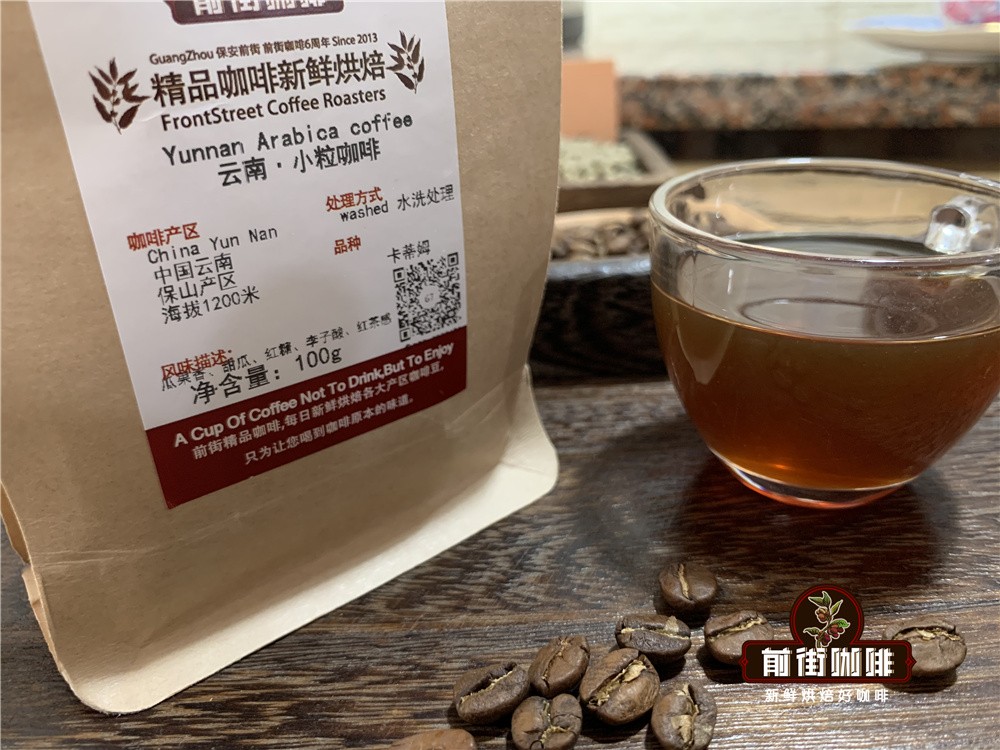
When it comes to the best origin of Yunnan arabica coffee, Baoshan is the representative. Its altitude is generally above 1,200 meters, with an average annual temperature of about 21.5°C (extreme high temperatures can reach 40.4°C), and basically no frost all year round. Its unique climate with distinct dry and wet seasons and volcanic soil create the classic flavor of arabica coffee: "strong but not bitter, fragrant but not harsh"—the beans are even and plump, and after brewing they are mellow and rich, with bright citrus or berry-like fruit acidity and a clean, refreshing finish, making them a preferred choice for pour-over enthusiasts.
For consumers, three main factors should be considered when choosing Yunnan coffee beans: first, the regional label (prioritize products from core regions such as Pu'er, Baoshan and Dehong); second, the processing method (washed processing highlights cleanliness and floral-fruity notes, while natural processing adds sweetness and body); third, the roast level (light to medium roast better preserves the bright acidity and floral-fruity aroma of arabica coffee). In addition, it is recommended to buy through proper channels products labeled with growing altitude and harvest year to ensure flavor stability.