Panama Hacienda Esmeralda Diamond Mountain Natural: Caturra and Catuai Flavor and Brewing Guide

Introduction: Hacienda Esmeralda is not just synonymous with Geisha coffee; its Diamond Mountain series Caturra and Catuai varieties are also worth exploring. This natural-process coffee from the high-altitude Boquete region has unique citrus and fermented wine notes, perfect for pour-over enthusiasts. This article details the cultivation background, processing methods, flavor characteristics, and practical brewing parameters of Diamond Mountain coffee, helping you better understand the charm of this specialty coffee bean.
When mentioning Hacienda Esmeralda, many people first think of the award-winning Geisha coffee. However, Hacienda Esmeralda carefully categorizes its coffee varieties. In addition to the well-known Geisha series (divided into Red, Green, and Blue labels), it also cultivates Caturra and Catuai varieties, launched under two brands: Diamond Mountain and Palmyra. Today, we will take a closer look at the Caturra and Catuai coffee beans from the Diamond Mountain series that are processed using the natural method.

These coffee beans are produced in the Boquete region of Panama, grown at altitudes between 1400 and 1700 meters, of the Caturra and Catuai varieties, and processed using the classic natural method. The high altitude gives the coffee brighter acidity and complex flavor layers, while the natural process further enhances the fruity aroma and sweetness, giving this coffee a distinctive character.
The history of Hacienda Esmeralda dates back to 1964, when American banker Rudolph Peterson retired and moved to Panama, buying this land in Boquete, initially mainly for dairy farming. It was not until 1987 that his son Price resigned from his medical career to help manage the farm and introduced the two coffee varieties, Caturra and Catuai. In 1994, the estate established its own washing station, gradually building a complete coffee production system.
It is worth mentioning that Geisha coffee was not originally the main focus at Hacienda Esmeralda. Because Geisha coffee trees are tall and low-yielding, they were once planted at the edge of the estate as windbreaks to protect other high-yielding coffee areas from strong winds. However, during an accidental harvest, people discovered that these coffee trees emitted charming floral and orange aromas, which drew further attention. In 2004, Geisha first competed and became famous overnight, putting Hacienda Esmeralda on the map.
Back to our main subject—the Caturra and Catuai of the Diamond Mountain series. These coffee trees are planted in two areas of the estate, Canas Verdes and Jaramillo, both at altitudes between 1400 and 1700 meters. These two areas have excellent climatic conditions, abundant annual rainfall, and significant temperature differences between day and night, providing an ideal environment for coffee growth. Among them, Canas Verdes receives an annual rainfall of 3500 mm, with an average daily temperature between 16 and 23°C; Jaramillo receives an annual rainfall of up to 4000 mm, with slightly higher temperatures, averaging 19 to 25°C during the day and 11 to 15°C at night.


Moreover, the Diamond Mountain series has obtained Rainforest Alliance Certified certification, which means that the coffee cultivation process strictly follows ecological protection principles, limits pesticide use, and emphasizes sustainable management of soil and water resources. In addition, the Panamanian government has awarded it an Eco-friendly label, further proving the environmental friendliness of its cultivation process.
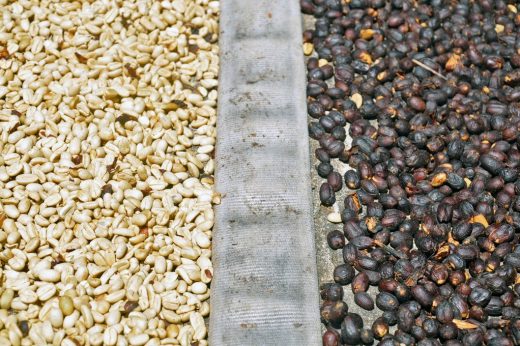
In terms of processing, these coffee beans use the traditional natural method. After harvesting, the coffee cherries are not immediately depulped but are directly placed on drying beds or concrete patios for natural drying, usually taking 3 to 5 days, during which they receive about 8 hours of sunlight each day. As the moisture gradually evaporates, the sugars and aromatic substances in the mucilage permeate into the coffee beans, giving them a rich fruity aroma and sweetness. To ensure uniform drying and prevent over-fermentation, the coffee cherries are subsequently moved to a Guardiola drier for further processing for 72 hours, and finally the skin and mucilage are removed mechanically.




In terms of green bean appearance, these natural-process Diamond Mountain coffee beans are yellowish in color with relatively more silver skin remnants. Among them, the Caturra variety has a slender bean shape with a natural curve at the tail, while Catuai is flatter with a more elongated tail. These details not only reflect variety characteristics but also help coffee professionals better identify them during selection.
For roasting, a medium-light to medium roast is recommended to highlight its bright acidity and rich fruity aroma. Taking a common semi-direct flame roaster as an example, the charge temperature can be set at 165°C, initial heat at around 130, and airflow at 3. As the temperature rises, gradually adjust the heat and airflow to ensure sufficient dehydration (usually adjust heat to 110 at around 151°C, keeping airflow at 4). First crack begins at around 10 minutes 48 seconds; at this point, increase airflow to 5 and complete the roast at 191°C, with development time controlled at about 1 minute 20 seconds to retain more floral and fruity notes and sweetness.
For brewing, a V60 dripper is recommended, with 15 grams of coffee grounds, a coffee-to-water ratio of 1:15, water temperature at 90 to 91°C, and a medium-fine grind (about 80% passing through a Chinese standard No. 20 sieve). Specifically, a classic three-pour extraction can be used: first, bloom with 30 grams of water for 30 seconds, then pour in a slow circular motion until 125 grams for the first pour, wait until the water level drops and is about to expose the coffee bed, continue pouring to 225 grams, and finally wait for the water to drain and remove the dripper. The total extraction time should be controlled at about 2 minutes. This effectively balances acidity, sweetness, and body, highlighting the complex flavors of citrus, honey, and a slight fermented note.





In cupping, the dry aroma of this Diamond Mountain natural coffee features distinct citrus and berry notes, while the wet aroma is mainly citrus. On the palate, it offers layered flavors of citrus, honey, cocoa, and fermented wine, with bright acidity and a soft cocoa finish. The overall mouthfeel is smooth and complex, making it highly recommended for pour-over enthusiasts who enjoy a balance of fruity and sweet notes.