How to Spot Real Blue Mountain Coffee Beans: Instant vs. Authentic and Buying Tips
Introduction: Blue Mountain coffee is world-famous for its distinctive flavor, but the huge price disparities among products on the market often confuse consumers. This article explains in detail the core characteristics of authentic Blue Mountain coffee beans, compares the essential differences between instant coffee and blended products, and exposes the common tricks of low-priced counterfeit goods. By analyzing the grading standards of Jamaica's Blue Mountain growing region, import regulations, and market pricing logic, it helps you accurately identify authenticity and avoid purchasing traps.
What are true Blue Mountain coffee beans?
Blue Mountain coffee specifically refers to Arabica coffee beans produced in the core growing region of Jamaica's Blue Mountain range (15° north latitude, 1,200–1,700 meters above sea level). Its flavor is known for gentle acidity, prominent sweetness, and balanced bitterness, with a silky-smooth mouthfeel. This unique quality comes from the slow ripening process brought about by high-altitude cultivation and the mineral nourishment of volcanic soil.
Blue Mountain coffee is divided into four grades: NO.1 (the highest grade), NO.2, NO.3, and peaberry. Among these, NO.1 selects only uniform beans of screen size 17 and above, with a defect rate below 3%, representing the top quality. During the 1970s and 1980s, this variety established its international reputation through promotion in the Japanese market. In the 1990s, after high-end hotels in China used it as beans for receiving foreign guests, it gradually became familiar to Chinese consumers.
Three key features of authentic products in circulation
First, all genuine Blue Mountain coffee enters China in the form of whole wooden barrels imported in their original packaging (standard specifications are 15 kg/30 kg/70 kg). Before 2011, domestic imports had to be transshipped via Hong Kong and other places; now customs clearance can be handled directly at the Hangzhou port. Second, the smallest sales unit is usually a 100-gram package, and the retail price is generally 3–5 times higher than that of ordinary specialty coffee beans—this is because the yield per hectare is less than 300 kg and the beans must be sorted by hand one by one.
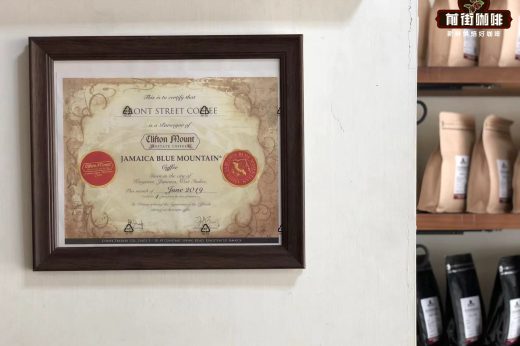
Special note: The Jamaica Coffee Industry Board (JACRA) implements strict grading of export products. Only green beans that pass density testing, defective-bean rate testing, and cupping scoring (≥85 points) can be labeled "Blue Mountain." Five legally designated estate farms, including Clifton Farm, must participate directly in the export process, and any third-party repackaging may affect quality stability.
These "Blue Mountain coffees" are all counterfeits
The first typical counterfeit is Blue Mountain flavor instant coffee (see  ). These products are mostly made from Vietnamese Robusta or low-altitude Brazilian beans blended with flavorings. Although the packaging bears Blue Mountain imagery, the instant process itself destroys coffee oils and aromatic substances, and there is an essential difference in flavor performance compared with freshly ground coffee.
The second common fraudulent method is the "Blue Mountain blend" or "Blue Mountain flavor" label (see  ). Merchants amplify bitterness through deep roasting (above 200°C) and mix in a small amount of Brazilian or Colombian beans to simulate the Blue Mountain taste. However, such blended beans usually contain 10%–30% raw material from non-Blue Mountain regions, and the true origin proportions are not clearly stated on the packaging.
The third low-price trap requires special attention: products claiming a 500-gram price below 200 yuan are 100% fake. According to industry estimates, after deducting the procurement cost at the Jamaican place of origin (about US$80–120/kg), international logistics, and tariffs, the reasonable retail price of NO.1-grade Blue Mountain coffee through proper channels should be no less than 15 yuan/gram. If you encounter a merchant that claims "imported from Jamaica" but cannot provide customs inspection and quarantine certificates, it is recommended to report them directly to the market regulatory authorities.
Professional buying advice
For consumers new to Blue Mountain coffee, it is advisable to give priority to products bearing a JACRA certification number and to ask the merchant to show a copy of the wooden-barrel shipping documents. When brewing, pay attention to the coffee-to-water ratio (1:15 recommended), water temperature (90–92°C), and grind size (medium-fine, similar to fine granulated sugar). The genuine product should present a clear citrus-like top note and a chocolate finish.