Brazil Coffee Variety Guide: 7 Regions, Pour-Over Parameters and Flavor
Introduction: Brazil is the world's largest coffee producer, and its beans are known for their consistent, full-bodied taste and low acidity, widely used in espresso blends and pour-over single origins. This article details the geographic distribution of Brazil's seven main producing regions (including São Paulo), the characteristics of the main varieties (such as Red Bourbon, Yellow Bourbon, and Catuai), and provides reference pour-over extraction parameters and typical flavor descriptions to help you understand Brazilian coffee comprehensively, from growing background to brewing practice.
When it comes to major coffee-producing countries, Brazil is undoubtedly the leader in South America and the world. As the country with the largest coffee planting area and production in the world, Brazil contributes nearly 45% of the world's green coffee beans. Changes in its dry season can even affect international coffee market price fluctuations. In recent years, Brazil's domestic coffee consumption has also been rising steadily, and it has now become the world's second-largest coffee consumer market after the United States.
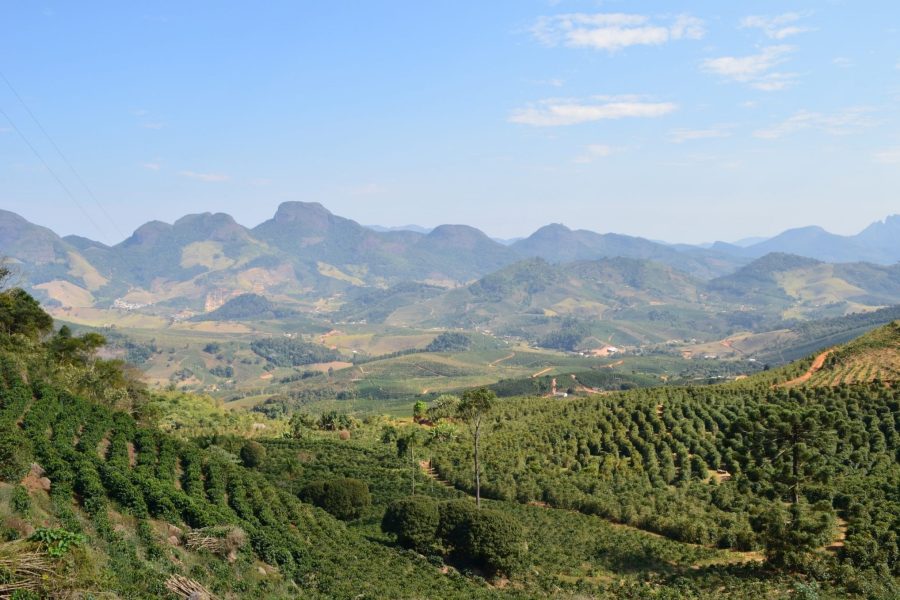
Brazil has 21 states, 17 of which produce coffee, and the 7 states with the most concentrated production contribute 98% of the country's coffee beans. These regions include São Paulo (such as Mogiana and Centro-Oeste), Paraná (Norte Pionerio do Paraná), Bahia (Planalto da Bahia, Cerrado da Bahia, and Atlantico Baiano), Espírito Santo (Montanhas do Espírito Santo and Conilon Capixaba), Minas Gerais (Sul de Minas, Cerrado Mineiro, Chapada de Minas, and Matas de Minas), Rondônia (Rondônia), and Rio de Janeiro (Rio de Janeiro).
The rise of Brazil's coffee-growing industry is quite legendary. As early as 300 years ago, there were no coffee trees in Brazil. In 1727, an army officer named Palheta was sent to French Guiana to mediate a territorial dispute. During this time, he caught the favor of the local governor's wife and was given a bag of Bourbon coffee seeds (some say coffee seedlings). After returning to Brazil, Palheta resigned from office and went to Pará province in the northwest near the equator to grow coffee, thus starting the boom in Brazilian coffee cultivation. Over the past two hundred years, coffee-growing areas gradually moved to the southeast and south, such as São Paulo, Espírito Santo, and Paraná. Because these regions are at higher latitudes (20-30 degrees south), they are prone to frost damage in winter. It was not until the 1970s-1980s that Brazilian coffee farmers began to develop provinces with lower latitudes and milder climates, such as Minas Gerais and Bahia (10-20 degrees south). Today, Minas Gerais is regarded as the new hope for Brazilian specialty coffee.
The coffee varieties grown in Brazil are rich and diverse, currently dominated by Red Bourbon, Yellow Bourbon, Mundo Novo, and Catuai. In addition, varieties such as Caturra, Acaia, Obata, Aramosa, and Laurina are also planted and studied to some extent. The Campinas Agricultural Institute in São Paulo is an important coffee variety improvement institution in Brazil. The globally widely planted Catimor variety was bred jointly by Portuguese and Brazilian scientists.
Mundo Novo is a hybrid of Bourbon and Typica and has been popular since the 1940s, especially in Latin America. Its advantages are strong disease resistance and high yield, but its flavor complexity is relatively weak. Catuai is a hybrid of Caturra and Mundo Novo developed in Brazil in the 1950s, with excellent disease resistance and high yield. Its ripe fruit naturally divides into red and yellow (red fruit is generally considered to have better flavor), and it is known for its full-bodied acidity. It is a common variety in Central American coffee regions.
Caturra is a Bourbon genetic mutation discovered somewhere in Brazil in the 1930s. It is popular because of its compact plant, high yield, and ease of picking. But note that if planted at lower altitudes, the coffee fruit can become too heavy and crush the plant, affecting quality. Therefore, Caturra is more suitable for planting on plateaus above 1,200 meters to ensure high-quality output. It is one of the classic varieties of the Central American coffee belt.
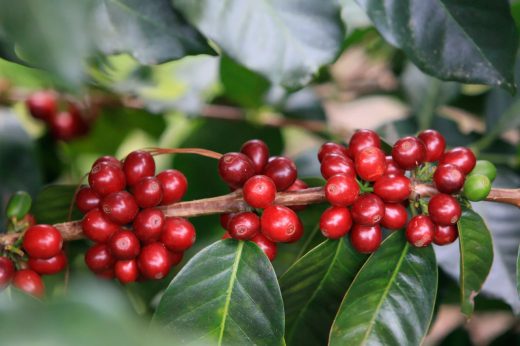
The Bourbon variety is named because its green fruit turns red when ripe, and Red Bourbon is the most common type. Bourbon itself is a mutation of Typica and is one of the oldest coffee varieties. Bourbon grown at high altitudes usually has prominent aroma and bright acidity. Yellow Bourbon and Pink Bourbon are also Bourbon variants: Yellow Bourbon fruit turns yellow when ripe and was first discovered and planted in Brazil, but its yield is lower and it is not resistant to wind and rain; Pink Bourbon is rarer, obtained by crossing Red Bourbon and Yellow Bourbon. Its pink fruit is controlled by a recessive gene and is highly susceptible to environmental interference, making stable production difficult.
Brazil's coffee-growing areas are mainly divided into two terrains: the Brazilian Plateau above 500 meters and the plains below 200 meters. Among them, Bourbon (including Red Bourbon, Yellow Bourbon, and the common flat bean Santos) is Brazil's most famous and widely planted variety. Brazilian coffee overall is characterized by low acidity, nutty notes, balanced taste, and moderate body. It may not stand out in the specialty coffee field, but it often plays an important role in espresso blends, and because of its high stability, it is often used as the base for "Blue Mountain flavor" blends.
There are many types of Brazilian coffee beans. Apart from a few special varieties, most are "high cost-performance" types suitable for mass-produced blended coffee, and are often dark-roasted. Whether for commercial blends or instant coffee, Brazilian beans are one of the main raw materials.
Brazilian coffee beans are relatively large, with a rich aroma, moderate bitterness, and good acidity. The overall taste is mild and smooth, with low acidity but rich layers. Its flavor often carries a light grassy aroma and a balance of sweetness and bitterness, with a smooth entry and a refreshing, comfortable finish. Because of this stable and balanced character, there is a common saying in the industry: "Without good Brazil, there is no good espresso."
For pour-over enthusiasts, Brazilian coffee is also worth trying. Take Red Bourbon from the Cerrado region of Minas Gerais as an example. This region is located in the prime area of the Brazilian Plateau, with higher altitude and fertile soil, and the coffee beans produced have a clean sweetness, high body, and excellent clarity. Brewing suggestions are as follows: use a Kono dripper, control the water temperature at 88°C, use 15 grams of coffee, a coffee-to-water ratio of 1:15, and a medium-fine grind with a 70-75% pass rate through the Chinese standard No. 20 sieve. Use a three-stage extraction: first bloom with 30 grams of water for 30 seconds, then pour in a small stream in circles until 125 grams and pause, and when the water level drops and is about to expose the coffee bed, continue pouring to 225 grams and stop. When it drops again and is about to expose the coffee bed, remove the dripper. The total extraction time should be controlled between 2 minutes 05 seconds and 2 minutes 15 seconds.


Red Bourbon brewed with these parameters has an obvious sweetness on entry, accompanied by a light caramel aroma and full nutty flavor, with a rich dark chocolate note in the finish. The overall taste is round and full, making it a classic choice for experiencing Brazilian coffee flavor.