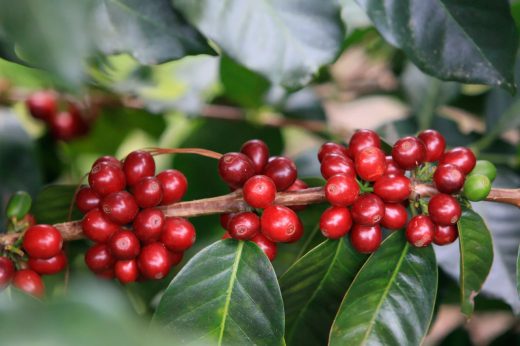
Brazil Alta Mogiana Natural Yellow Bourbon: Flavor and Pour-Over Guide
Introduction: Brazil is the world's largest coffee producer, and its high-altitude Alta Mogiana region in São Paulo state is known for high-quality Arabica. This article focuses on the natural Yellow Bourbon from Fazenda Rainha in this region, detailing its 1,400–1,950 m growing environment, the chocolate and nut flavors brought by its distinctive processing, and the key parameters and techniques for pour-over extraction, helping you experience the mellow balance of Brazilian specialty coffee.

As the coffee kingdom accounting for about 45% of global coffee production, Brazil's Arabica is known for its plump beans and mild aroma; it suits single-origin pour-over and is also a common base for espresso blends. The country spans South America, and the volcanic soils and tropical climate east of the Andes provide ideal conditions for coffee growing. Of the country's 26 states, 17 produce coffee, with four states including Paraná and São Paulo contributing 80% of output.

South America's unique geography—including volcanic activity in the Andes and abundant tropical rainforest and savanna rainfall—has created fertile soils and suitable temperatures, helping Brazil become the world's third-largest coffee exporter, with one-third of the international market. Its main coffee regions are concentrated on the southwestern plateau at 600–800 m, with some ridges above 2,000 m; the mild, humid subtropical monsoon climate and ample sunshine further optimize growing conditions.

Among Brazil's many regions, Alta Mogiana in São Paulo state stands out. The area's varied terrain, with inland plateaus and basins and a tropical highland climate with large day-night temperature swings, and growing elevations of 900–1,100 m (some areas such as Fazenda Rainha reach 1,400–1,950 m) give the coffee richer layers of flavor. The region's mineral-rich soils provide ample nutrients for the coffee trees.

Alta Mogiana's well-known Fazenda Rainha is run by the locally long-established Carvalho Dias family and focuses on growing quality Bourbon varieties. The farm adheres to environmental principles, using natural waterfalls for power, protecting primary forest and continuing reforestation, and relies on hand-picking to ensure quality. Its natural-process Yellow Bourbon, dense and high in glucose due to the high-altitude environment, shows a distinctive sweetness and mellow balance.

Fazenda Rainha's natural Yellow Bourbon has distinct flavor characteristics: in cupping one detects ripe fruit sweetness, along with a complex aroma of sugarcane, black tea, chocolate and peanut-nut notes, clean and faint bitterness, and a smooth, delicate mouthfeel. The density and sugar characteristics of these beans call for roasting that highlights the classic mellow base of Brazilian coffee; a medium-dark roast better balances sweetness and aroma.

Pour-over of this Brazilian natural coffee requires parameter control to avoid over-extraction. A medium-low water temperature of 87–88°C is recommended, with a medium-coarse grind (similar to granulated sugar) at 70% passing a Chinese standard No. 20 sieve, and a 1:15 coffee-to-water ratio. For 15 g of coffee, use three-stage pouring: first bloom with twice the coffee weight in water (about 30 g) for 30 seconds until a dome forms; then pour in a small stream in circles from the inside out to 125 g in stages; when the bed drops to half the height of the dripper, continue with a fine stream to 225 g to finish extraction, about 2 minutes total. This method reduces the release of bitter compounds while the KONO dripper enhances body and roundness.

In actual brewing, this natural Yellow Bourbon shows intense aromas of dark chocolate, cream and peanut, a sugarcane-like sweetness on the palate, bright and balanced flavor, and a lingering finish. Note that high-altitude beans are tightly structured, and too fine a grind or too high a temperature can easily cause over-extraction; adjust parameters slightly based on actual flavor feedback.