Brazil Yellow Bourbon: Flavor Profile and Pour-Over Guide
Introduction: Brazil Yellow Bourbon is a distinctive rare variety in the Arabica family, known for its mild acidity and nutty-chocolate notes. This article covers the variety's origins, the principles of fruit color change, optimal roasting and brewing methods, and provides professional brewing parameters.
In the early 18th century, coffee cultivation spread from Africa to South America. Brazil, one of the first countries to introduce coffee, initially planted large areas of the Typica variety. Although Typica is considered an important foundation of modern coffee genetics, its low yield and susceptibility to disease made it difficult to meet commercial demands.
By the mid-19th century, the Bourbon variety was introduced to the Campinas region in southern Brazil. Compared to Typica, Bourbon yields about 30% more and adapts well to the local environment, gradually becoming the main cultivated variety. Today, Red Bourbon, Yellow Bourbon, and hybrids such as Mundo Novo remain the backbone of Brazilian coffee cultivation.

Brazilian agricultural research institutions have long been committed to breeding adaptable coffee varieties. Among them, the Campinas Agronomic Institute (IAC) maintains a large collection of genetic resources, including common varieties such as Caturra and Catuai, but ultimately due to climate adaptability issues, Red Bourbon and Yellow Bourbon still dominate.
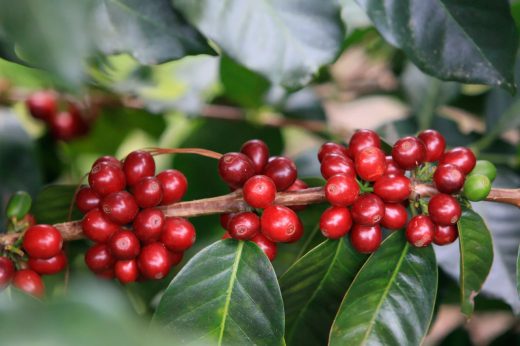
Normal Bourbon fruits follow a typical color evolution: green when unripe, then turning yellow-orange, and bright red when fully ripe. The uniquely Brazilian Yellow Bourbon variety, however, retains a bright golden-yellow color when ripe, a characteristic that clearly distinguishes it from conventional red-fruited Bourbon.

There are two hypotheses about the origin of Yellow Bourbon: one is that it is a natural mutant of Red Bourbon, and the other is that it originated from a cross between Red Bourbon and a Typica mutant. Historical records show that the variety was first discovered in 1930 in the Pederneiras region of São Paulo state, Brazil.
Scientific research on fruit color variation began in 1942. Botanist Krug named it "Xanthocarpa" through genetic analysis, where "Xanthus" means yellow in Greek and "carpus" refers to fruit. Modern research shows that coffee fruit skin color is regulated by anthocyanins; when the dominant gene XcXc is present, the fruit appears red, while under the recessive gene XCXC, the natural yellow of the flavonoid luteolin is expressed.

In the early stages of promotion, Yellow Bourbon was favored for its high yield and quality flavor, but later problems with declining yield and reduced disease resistance emerged. Currently, this variety is only planted in small quantities in some high-altitude areas of São Paulo state (such as Mogiana), with an ideal growing altitude of over 1000 meters; large day-night temperature differences help accumulate flavor compounds.
Yellow Bourbon is usually processed using the semi-dry or honey method to preserve its bright sweetness. For roasting, a medium-dark roast (dense first crack to the beginning of second crack) can balance its nutty base and caramelized aroma, avoiding excessive development of smoky flavors. For brewing, a water temperature of 90-93°C is recommended, with a grind size between medium-fine and medium-coarse (about 70-75% passing through a Chinese standard No. 20 sieve).

In terms of flavor, Yellow Bourbon exhibits a unique mild character: acidity as soft as fresh citrus, sweetness close to caramel pudding, accompanied by a distinct roasted almond and dark chocolate finish. Compared to the bright acidity of Red Bourbon, Yellow Bourbon is rounder on the palate with a lower bitterness threshold, suitable for drinkers who prefer balanced flavors.
Recommended professional brewing method: V60 dripper with 15 grams of coffee, water-to-coffee ratio 1:15, maintaining a steady flow when pouring in stages. In the initial pour-over, use a center pour to activate the coffee bed, then expand the water flow range to promote even extraction. If using a French press, it is recommended to extend the blooming time to 45 seconds to fully release the floral and fruity aromas.

Sensory evaluation data shows that the main flavors of Yellow Bourbon are concentrated in the sweetness expression from the mid to late stages, with common descriptors including: toffee, roasted peanuts, honey toast, and other warm flavors. Its body is medium to full, with a mouthfeel similar to whole milk, and a clean finish without astringency.
For coffee enthusiasts, Yellow Bourbon is an excellent choice for exploring the diversity of Brazilian specialty coffee. High-altitude cultivation gives it more complex aromatic layers, and its stable genetic characteristics allow it to maintain core flavor characteristics under different processing methods. Whether for daily drinking or cupping practice, this classic variety provides a reliable reference for tasting.