Common Espresso Puck Problems: Channeling, Water Pooling, and Clumping
Introduction: When making espresso, the state of the puck is often one of the key indicators of whether extraction succeeded. From craters and holes on the puck's surface to water pooling, looseness, or even patches of abnormal color, every detail can reflect issues with grind size, dose, tamping technique, or equipment performance. This article analyzes six common espresso puck problems in detail—including channeling and water pooling, loose pucks, and clumping—covering their causes and corresponding adjustments to help you precisely optimize extraction parameters and improve the quality and consistency of your espresso.
Making a quality shot of espresso requires not only understanding the roast level and freshness of the coffee beans, but also finely tuning multiple parameters such as grind size, dose, extraction time, and pressure. Among these technical details, the final state of the puck is an intuitive and important reference. By observing the puck's shape, color, and firmness, as well as whether there is water pooling or holes, we can quickly identify potential problems in the last extraction and adjust parameters accordingly, thereby stabilizing output quality.

So what does an ideal espresso puck look like? Simply put, it should present a uniform, intact bowl shape, with a flat surface and even color, a dense texture that does not crumble easily, and no obvious water pooling or holes. Such a puck usually means the water flow was evenly distributed, extraction was thorough, and pressure was stable, so the coffee's flavor will also be more balanced. Conversely, if the puck shows various abnormalities—such as an uneven surface, obvious holes, severe water pooling at the bottom, or an overall loose and crumbly structure—it means there are aspects of the extraction that need optimization.

Below, we will analyze the six common espresso puck problems and their causes one by one, and provide actionable adjustment suggestions.
1. A cratered, uneven puck surface
This is a situation many baristas encounter, whether beginners or experienced. An uneven puck surface with craters usually indicates that during extraction the water flow was not well guided and some areas received water unevenly. A common cause is that the puck is overall too thick—especially when using dark-roasted beans with a high expansion rate, the coffee layer will be thicker for the same dose, easily pressing close to the shower screen and hindering even water penetration, which leads to uneven extraction, often accompanied by weak or sour flavors.
Solution: Try grinding finer and reducing the dose to make the coffee layer thinner so water can pass through more evenly.

2. Holes in the puck (channeling)
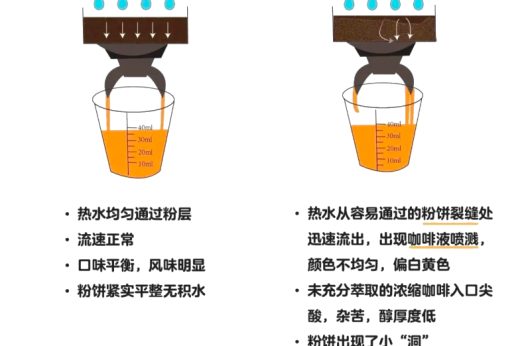
One or more obvious holes in the puck are a typical sign of the "channeling effect." Because the density inside the puck is uneven, water tends to take the path of least resistance and pass through quickly, causing localized over-extraction while other parts are under-extracted. This phenomenon may also come with unstable flow rate and coffee spraying.
Solution: Focus on checking whether the coffee grounds are clumping, and after dosing, perform a thorough and even distribution to ensure consistent puck density.

3. Severe water pooling on the puck
In contrast to the cratering problem, water pooling usually occurs when the coffee layer is too thin. When the grind is too fine, the gaps between coffee particles become smaller, and for the same dose the overall puck height decreases, creating a larger gap between the puck and the dispersion screen. Water then lingers longer, and the moisture cannot be fully absorbed by the coffee grounds, forming surface pools. In addition, if a home espresso machine cannot stably provide 9 bar of pressure, extraction efficiency is also affected, leading to water retention, under-extraction, and even liquid dripping straight through.
Solution: Grind slightly coarser and increase the dose to increase the puck's thickness and density and improve water flow distribution.

4. A loose, wet, mushy puck
An ideal puck should be firm and somewhat resilient. If the puck is loose, wet, or even mushy, it usually means that during extraction the water pressure was too concentrated or the dose was insufficient, causing the particles to absorb too much water and the structure to break down. In this case, although the flow rate may be within the normal range (such as a 1:2 brew ratio with an extraction time of 25–35 seconds), the coffee often tastes bitter and lacks complexity.
Solution: Increase the coffee dose appropriately, or consider switching to a single basket to avoid an insufficient dose.

5. One side of the puck dry, the other wet
This problem is usually caused by uneven force during tamping, which makes the puck surface uneven in height. Water naturally passes preferentially through the area of lower resistance, causing over-extraction on one side and under-extraction on the other. When tamping, try to keep the force balanced; a standard tamping technique is recommended: secure both sides of the tamper with your thumb and index finger, support the handle with the other three fingers and the palm, and press down while keeping the tamper vertical.

6. A dark bottom on the puck
During normal extraction, water gradually penetrates from top to bottom. If extraction is ended early, the flavor compounds in the lower layer of coffee grounds may not have had time to be released, leaving the bottom abnormally dark and wet, and the coffee overall thin with a short finish. Ensure extraction is complete, usually using a 1:2 brew ratio as a reference; if the time is too long, grind slightly coarser to speed up the flow.
Solution: First complete extraction at a 1:2 brew ratio; if the time is still too long, grind coarser to optimize flow rate.

In summary, the puck is not merely a "byproduct" of extraction but an important visual clue for diagnosing espresso-making problems. By systematically observing the puck's shape, color, and structure and combining that with flow rate, pressure, and time parameters, coffee enthusiasts and professionals alike can optimize the extraction process more scientifically and consistently produce high-quality espresso.