Pour-Over Coffee for Beginners: 7 Key Techniques to Improve Extraction and Flavor
Introduction: Pour-over coffee looks simple, but brewing a cup with balanced flavor and rich layers is not easy. This article systematically explains the seven core factors that affect pour-over coffee quality, including coffee bean freshness, grind size, water temperature control, water quality selection, dripper type, coffee-to-water ratio, and brewing time, and analyzes the principles of extraction to help beginners master professional-level brewing techniques and avoid common mistakes.
 With the spread of specialty coffee culture, pour-over coffee has become the first choice of many coffee enthusiasts because of its flexible operation and clear flavor expression. But for beginners who have just encountered it, the wide array of equipment and complex parameter settings often feel overwhelming. Through seven key factors, this article will help you clarify the core logic of pour-over coffee and master the basic methods for consistently producing good coffee.
 First is the choice of coffee beans—freshness is the foundation of flavor. After roasting, coffee beans continue to release carbon dioxide while aromatic substances gradually volatilize. It is generally recommended to choose beans within 30 days of roasting, when flavor compounds are best preserved. Beans stored too long taste flat because their aroma has been lost, and may even carry a cardboard flavor.
 Grind size directly affects extraction efficiency. The finer the coffee grounds, the greater the resistance to water flow, the longer the extraction time, and the more likely woody or burnt-bitter flavors become; conversely, grinding too coarse leads to under-extraction and thin flavor. A practical way to judge the right grind size is to use a No. 20 standard sieve (0.85 mm aperture): grind 10 grams of coffee beans and sift them; for medium-light roasted beans, about 8 grams should pass through (80% pass rate), and for medium-dark roasted beans, 7–7.5 grams (70%–75% pass rate). If the standard is not met, adjust the grinder setting accordingly.
 Water temperature is a key parameter for controlling extraction flavor. For medium-light roasted beans (such as Ethiopian Yirgacheffe), 90–91°C hot water is recommended, which can fully extract floral and fruity acidity and sweetness; for medium-dark roasted beans (such as Colombian Mandheling), it is better to lower the temperature to 87–89°C to avoid over-extracting burnt-bitter off-flavors. Water that is too hot makes coffee astringent, while water that is too cool makes the flavor dull.
 The impact of water quality on extraction is often overlooked. Too high a content of minerals such as calcium and magnesium in tap water will interfere with the dissolution balance of coffee molecules. Filtered water or mineral water is recommended, with the TDS value (total dissolved solids) controlled between 100 and 200 ppm. Avoid using untreated hard water directly, otherwise metallic flavors or scale residue may appear.
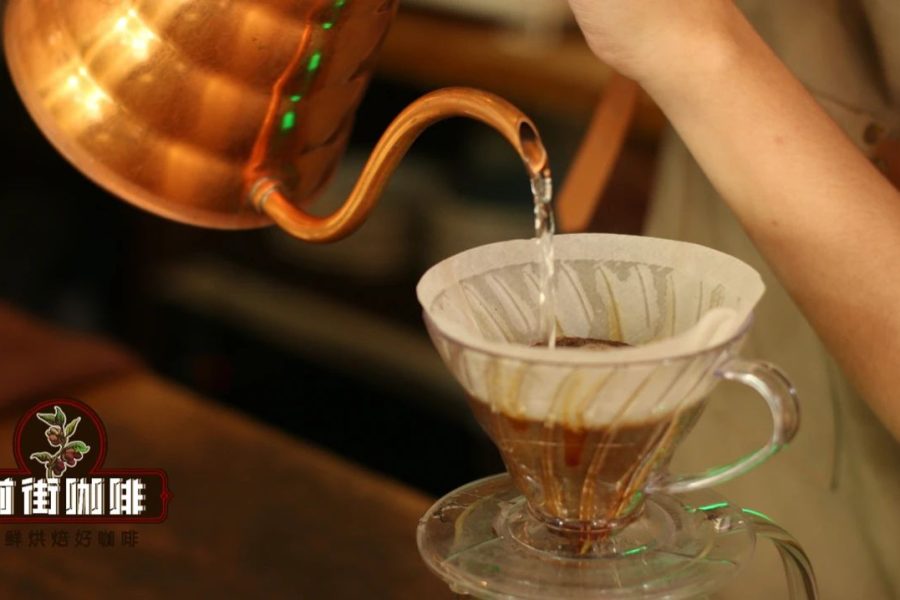
 The choice of dripper directly affects extraction uniformity. For beginners, it is recommended to start with the V60 01 cone dripper—its large opening design combined with a spiral rib structure accelerates air release, allowing water to penetrate the coffee bed more smoothly, with higher extraction efficiency and greater tolerance for operational error. Although the body may not be as full as with a thick-walled dripper, the sweet-and-sour aroma is vivid, making it suitable for practicing flavor identification.
 The coffee-to-water ratio determines the concentration and strength of the coffee. Referring to the Golden Cup extraction theory, 1:14.5–1:15.5 (for example, 15 grams of coffee with 220–230 milliliters of water) is the range in which it is easiest to achieve the ideal extraction yield (18%–22%) and concentration (1.15%–1.35%). For a richer mouthfeel, choose 1:12–1:13; for a lighter flavor, use 1:16–1:18. For a first attempt, it is recommended to fix the ratio at 1:15 and then fine-tune according to personal taste.
 Brewing time is closely related to the rhythm of flavor release. The early stage of coffee extraction mainly extracts acidity and aroma, the middle stage presents sweetness, and the late stage releases bitter substances. Taking 15 grams of coffee and a 1:15 coffee-to-water ratio as an example, the total extraction time is recommended to be completed within 2 to 2 minutes 30 seconds, which ensures full extraction while avoiding off-flavors caused by over-steeping.
 Understanding the principles of extraction can help you control the process better. Coffee brewing is essentially three consecutive steps: first is the wetting stage (bloom), in which hot water contacts the coffee grounds, causing them to expand and release carbon dioxide, paving the way for subsequent dissolution; then comes the dissolution stage, in which hot water dissolves the soluble substances in the coffee cells (about 30% of the bean, including flavor molecules such as acids, sweets, and bitters), among which small-molecule acidic and aromatic substances dissolve first, medium-molecule sweet substances follow, and large-molecule bitter substances are released last; finally is the diffusion stage, in which the dissolved molecules enter the water through osmosis to form a uniform extraction liquid, so after brewing, gently swirl the coffee server to mix the liquid.
 Taking a typical medium-light roasted bean as an example (assuming a high-altitude origin and natural processing), the recommended specific parameters are: use a V60 01 dripper, adjust the grind size to a No. 20 sieve pass rate of 80% (similar to Chinese standard BG#6S), water temperature 90°C, coffee-to-water ratio 1:15. During operation, first pour 30 milliliters of water and bloom for 30 seconds (the water amount is about twice the coffee dose), then pour in a thin stream in circles until 125 milliliters and pause, and when the water level drops to the surface of the coffee bed, continue pouring to 225 milliliters, with the total time controlled at about 2 minutes. Under these parameters, bright citrus acidity, berry sweetness, and a moderate tea-like finish can usually be expressed.
 In summary, the core of pour-over coffee lies in balance—fresh beans provide the flavor foundation, suitable grind size and water temperature ensure effective extraction, quality water and an appropriate ratio bring balanced concentration, and the dripper and technique affect the final mouthfeel. By repeatedly practicing parameter combinations and recording flavor changes, you will gradually find your own best brewing formula.