A Complete Guide to Guatemala's Coffee Regions: Grading Standards and Flavor Profiles
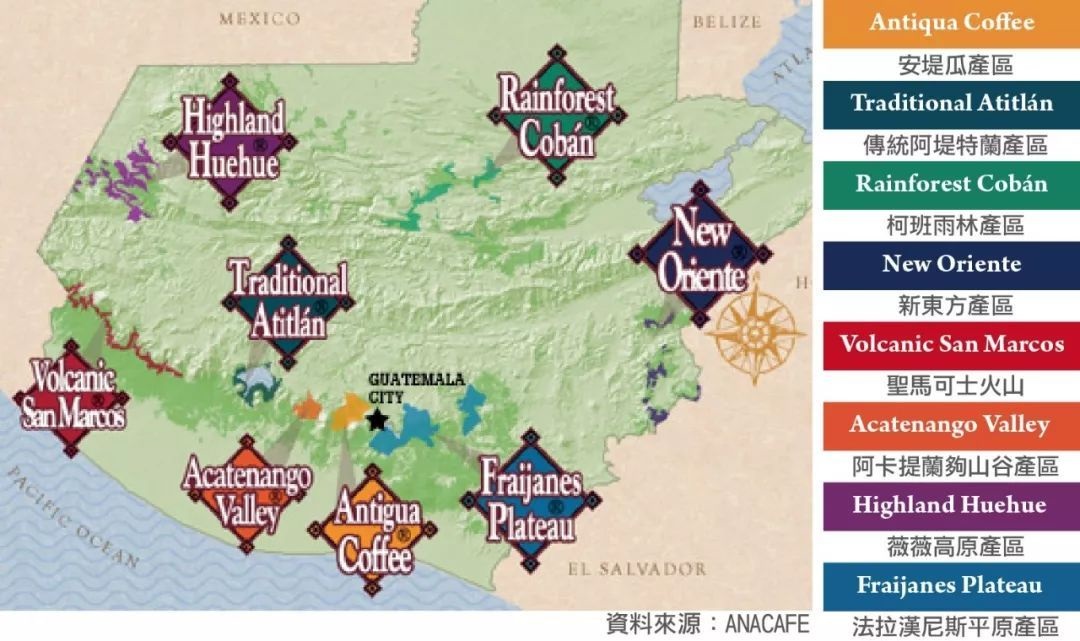
Introduction: Guatemala's coffee is known worldwide for its distinctive regional flavors, as the terroir of each growing area shapes a wide range of cup profiles. This article takes an in-depth look at the altitude, climate, harvest periods, and variety characteristics of Guatemala's eight main coffee regions, explains the quality logic behind grading standards such as SHB (Strictly Hard Bean), and describes the flavor characteristics of coffee from each region to help you choose beans suited to pour-over or roasting.
Coffee cultivation in Guatemala dates back to 1750, when missionaries first introduced coffee trees. Driven by agricultural policies between 1856 and 1880, coffee gradually replaced traditional crops as the economic mainstay, and at its peak accounted for as much as ninety percent of exports. The civil war from 1960 to 1996, however, left deep and lasting effects, and although production recovered after 2000, issues of land distribution and indigenous rights still affect the fairness of the coffee industry. Today, from family farms to cooperatives, Guatemalan coffee still maintains a traceable production system.
The country's coffee flavors are strongly influenced by its geographical diversity: the Antigua region is known for its bright acidity, while other areas may show richer fruit or chocolate notes. Professional roasters often use regional information to anticipate flavor profiles—for example, coffee from high-altitude regions usually has a firmer body and more complex layers.
The altitude grading system is the core standard of Guatemalan coffee quality: growing height directly affects green bean density and the final grade. SHB (Strictly Hard Bean) requires an altitude above 1,300 meters; these beans are dense with lively acidity, suited to pour-over enthusiasts seeking a bright cup; HB (Hard Bean) ranges from 1,220 to 1,300 meters, balancing body and flavor clarity; while SH (Semi-Hard Bean) ranges from 1,050 to 1,220 meters and shows softer characteristics. Extra Prime (900–1,050 meters) and Prime (750–900 meters) at mid-to-low altitudes are mostly washed, suited to consumers who prefer a milder cup.
The San Marcos volcanic region has the country's warmest growing environment; coffee farms between 1,300 and 1,800 meters benefit from abundant rainfall brought by Pacific air currents, but the humid weather during the harvest season (December to March) often requires sun-drying or mechanical drying techniques. Classic varieties such as Bourbon and Caturra are mainly grown here, and their early flowering period offers a unique window for farm scheduling.
The Acatenango Valley surrounds Guatemala's most challenging active volcano. Although it historically relied on Antigua's processing system, local coffee now commands a premium thanks to clear traceability. The growing belt at 1,500–1,700 meters includes traditional varieties such as Typica, which together with Bourbon and Catuai forms a diverse flavor matrix.
Coffee farms in the Lake Atitlan region sit on the shores of a volcanic lake at 1,500 meters. The stunning scenery attracts many visitors, but rising labor costs are threatening production continuity. The region insists on old varieties such as Bourbon and Typica, and the December to March harvest requires careful control of ripeness to maintain flavor purity.
The Coban region is named after the historic town of the same name; the planting traditions established during the German colonial period give it a unique coffee gene pool. The rainforest climate at 1,300–1,500 meters makes drying more difficult, but rare varieties such as Maragogype show exceptional potential here, making it especially suited to experimental coffee enthusiasts exploring special processing.
The New Oriente region is a relatively young coffee belt in Guatemala; its proximity to Honduras gives its growing patterns a border character. The dry, low-rainfall environment leads smallholders to focus on drought-tolerant varieties such as Bourbon and Pache, and the 1,300–1,500 meter altitude range produces Central American coffee with good value for money.
The Huehuetenango region is home to a rare non-volcanic mountain range in Central America; the extremely high altitude of 1,500–2,000 meters creates excellent acidity, and the long harvest period from January to April allows finer grading and sorting. Coffee produced here often has distinctive floral notes and is a frequent contender in specialty coffee competitions.
The Fraijanes region's volcanic soil gives its coffee a rich mineral character, but urbanization is gradually squeezing the growing area. The environment at 1,400–1,800 meters suits drinkers seeking a full-bodied cup, and dwarf varieties such as Pache perform outstandingly here.
As Guatemala's most internationally renowned region, Antigua—a 1,500-meter plateau surrounded by three volcanoes—is not only an appellation but also a quality benchmark. The January to March harvest window strictly controls ripeness, and the combination of Bourbon and Catuai creates a balanced, elegant classic flavor much admired by roasters worldwide.