Indonesian Wet-Hulled Coffee: Why It Tastes Unique and the Full Process
Introduction: Indonesian coffee is known for its distinctive low-acid, full-bodied style, with Sumatra Mandheling as one of its best-known examples. All of this is closely tied to its special wet-hulling process. This article takes you through the origins of wet hulling, its processing steps and its influence on coffee flavor, including why this method produces distinctive herbal and woody aromas. It is suitable for readers interested in coffee processing methods and regional flavors.
When people mention Indonesian coffee, many immediately think of Mandheling, known for its unique flavor and low-acid, full body. It not only has lower acidity and a full body, but often also carries a faint herbal and woody character. These traits are not only related to the local growing environment, but are also closely tied to its special wet-hulling process.
Wet hulling, the signature processing method of Indonesian coffee, is known locally in Indonesia as “Giling Basah.” This method has a long history in the coffee industry and is still widely used today in producing regions such as northern Sumatra and Sulawesi, where it is one of the main coffee processing methods. Compared with other common methods such as washed, natural and honey, wet hulling is more distinctive and better suited to Indonesia’s hot, humid climate.
Sumatra is Indonesia’s main coffee-producing region. The island is divided into eight provinces, but the areas truly suited to high-quality Arabica cultivation are mainly the high-altitude regions of Aceh and North Sumatra. The climate here is variable, with humidity staying between 70% and 90% year-round and frequent rainy seasons; sometimes sun and rain alternate within a single day, and annual rainfall exceeds 2,000 mm, posing a huge challenge to conventional coffee drying.

In such a humid, rainy environment, using traditional natural or washed methods to let coffee beans dry naturally to a safe moisture content not only takes a long time but is also extremely risky. To speed up coffee processing and circulation, local coffee farmers gradually developed a processing method suited to the environment—wet hulling—which effectively solved the problem of drying coffee in a highly humid environment.

The earliest Sumatran coffee also experimented with natural processing, but because the climate was unstable and quality was hard to control, it later shifted to a semi-natural method similar to Brazil’s. Farmers first removed the outer skin of the coffee cherry, placed the parchment beans in a water tank to remove floaters, briefly fermented the sunken high-quality beans for a few hours, then washed and dried them. But unlike Brazil’s dry climate, Indonesia’s heat and humidity make long outdoor drying almost impossible; parchment beans often dry for only one or two days before absorbing moisture again, making it hard to reach a moisture content safe for storage.

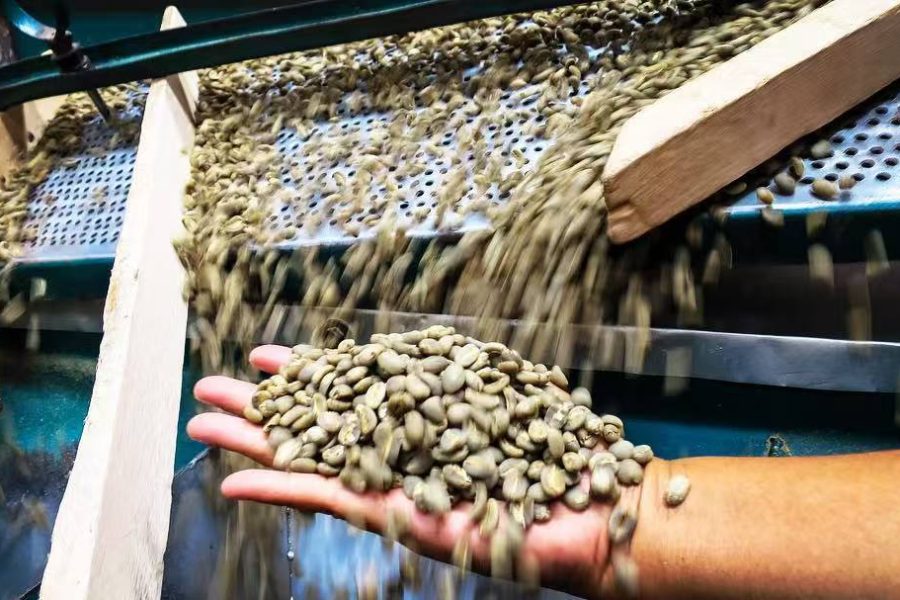
At this point the parchment beans have a moisture content of about 30% to 50% and are still fairly wet, but so as not to affect sales and processing schedules, these not-yet-fully-dried beans are sent to processing plants for the next step. Then a key step appears: using specialized machinery to hull off the seed shell, that is, the parchment layer, from the outside of the beans. This process is exactly where the name “wet hulling” comes from.

It should be noted that the hulling machines used in wet hulling usually require greater power and friction, because the parchment beans are still semi-wet and relatively soft at this stage. During this process, the silverskin and seed shell on the surface of the green beans are stripped off early, while the interior of the green beans, which has not yet fully stabilized, is directly exposed to the air; the color often turns grayish-green and the texture becomes more easily damaged. During processing, white or green mucilage may also seep onto the surface of the beans, and friction and squeezing can easily cause notches at both ends of the beans, forming a shape like a “sheep’s hoof,” which is one reason Sumatra coffee has a relatively high proportion of hoof-shaped beans.

The biggest difference between wet hulling and traditional processing methods is that it removes the parchment layer (seed shell) and silverskin in advance, so that before the green beans are fully dried, they are exposed and undergo subsequent sun-drying or air drying. This not only greatly shortens the overall processing time, but also changes the drying rate and flavor development path of the coffee beans.

Usually, the beans after wet hulling continue to be dried until the moisture content drops to the safe range of 12% to 15%, only then are they collected and bagged, generally in 40 kg or 80 kg bags, and finally enter the machine sorting and grading process. Because the whole processing cycle is shorter, wet hulling can save a great deal of labor and time cost, but it also brings a higher risk of defects.

From natural defects at picking, to possible crushing during hulling, to uneven transport and drying in a humid environment, every stage can increase the proportion of defective beans. Therefore, high-quality Mandheling coffee often needs to go through multiple rounds of manual hand sorting to ensure the purity and consistency of the final product.

Interestingly, although wet hulling increases the risk of microbial growth, the action of certain molds actually gives Indonesian coffee its unique flavor characteristics. The academic community generally believes that the woody notes, herbal aromas, earthy scents and even spicy flavors commonly found in Sumatra coffee likely come from the involvement of these microorganisms. Combined with subsequent Maillard reactions and caramelization, this ultimately forms the rich, musty aroma we are familiar with—the so-called “taste of place.”

In summary, the distinctive herbal and dark-wood aromas of Mandheling coffee are closely related to the high humidity of its growing environment, and even more closely tied to the special wet-hulling process. By removing the protective layer in advance and allowing the coffee beans to dry quickly while still moist, it not only adapts to Indonesia’s climate characteristics but also unintentionally shapes a highly recognizable coffee flavor that is worth savoring carefully by every coffee lover.