Guatemala Coffee Beans: History, Washed Process and Pour-Over
Introduction: Guatemalan coffee beans are known for their unique high-altitude cloud-forest environment and rich variety. Their flavor is complex, with both a smoky underpinning and fresh citrus notes. This article examines Guatemala's core coffee regions and the characteristics of six mainstream varieties, details the six key steps of the washed process, and provides a professional roasting curve and medium-roast flavor profile. Pour-over parameters and a flavor evaluation are included to help you grasp the brewing essentials of this classic bean.
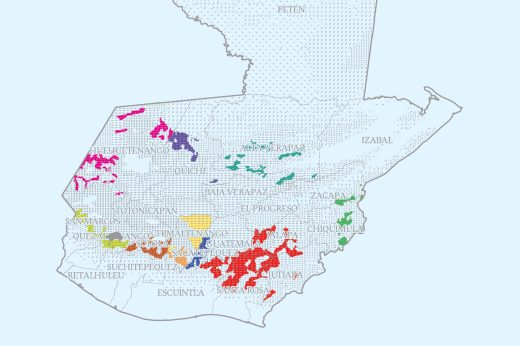
Guatemala's coffee-growing miracle begins with its exceptional geography. Coffee farms are generally located in the cloud belt at 1,500–2,000 meters, where the day-night temperature difference can reach 10–12°C. This slow-growth environment encourages the beans to accumulate more flavor compounds. The acidic soil formed from volcanic ash is rich in minerals such as potassium and phosphorus. The cirque terrain of the Huehuetenango highlands is particularly distinctive: morning clouds reduce direct sunlight, while afternoon sun breaks through to provide even light, creating the bright acidity and citrus character typical of this region's coffee.
The Antigua region around the capital is dominated by altitudes of around 1,600 meters, and its volcanic-rock soil gives the coffee a deeper palate. Coffees from here often carry a subtle smoky finish, contrasting sharply with the citrus freshness of the Huehuetenango highlands; together they build Guatemala's diverse flavor map.
The country's variety structure shows a clear Arabica dominance: 98% is shade-grown, mainly the four traditional varieties Bourbon, Typica, Caturra and Catuai, plus newer hybrids such as Pache and Pacamara. Bourbon has the largest share; its rounded bean shape and consistent sweetness make it the base choice for most specialty estates. Catuai, with strong wind resistance and stable yields, is popular in hillside planting areas.
Guatemala's washed process is a Latin American model, and its standardized flow includes six key steps: ① flotation sorting → ② pulping → ③ mucilage fermentation → ④ washing → ⑤ drying → ⑥ hulling. In practice, harvested coffee cherries rest in a water tank for 12–24 hours, where density differences naturally separate unripe fruit and debris. A drum pulper removes the pulp while leaving the mucilage layer intact before the beans enter fermentation tanks, where microbial fermentation proceeds for 36–48 hours at 20–25°C until the mucilage rinses off easily with water. During drying, the daily moisture loss of the bean surface must not exceed 3%, and hulling takes place once moisture is brought to 11–12%.
Specialty lots such as Finca El Milagro Green Veina typically blend Bourbon, Catuai and Caturra. These green beans have a blue-green luster, a density of 0.72–0.75 g/cm³ and a stable moisture content of about 11.5%. Their flavor matrix is as follows: roasted almond and caramel in the dry aroma; dark chocolate body once brewed; citrus acidity and honey sweetness in the middle; a faint cedar smokiness in the finish; and excellent overall balance.
For these medium-to-high-density green beans, a medium-light to medium roast is recommended. During roasting, pay special attention to their high moisture content: the charge temperature should be set at 200±2°C, with three-stage heat control. In the drying phase (0:00–5:30), hold 160–140°C with the damper at position 3; after the yellowing point, gradually lower to 100–80°C and open the damper to position 5 to ensure the bean core develops fully before first crack. Drop the beans when the drum temperature reaches 194–195°C; the bean color should then be an even deep amber with less than 3% silver skin remaining.
For pour-over optimization, the classic V60 ratio of 15 g coffee to 225 ml water is recommended, with a 4M medium-coarse grind (about 70% passing a No. 20 sieve). For pre-infusion, pour 40 ml of 92°C water and let it bloom for 30 seconds, then pour in two stages: first to 130 ml and pause, then in a circular pour to 225 ml to complete extraction. At a total time of 2:04, the optimal flavor window appears: the sweet-sour-bitter ratio is about 3:4:1, the body reaches Medium+, and the citrus note is clearly discernible without sharp acidity.