Tanzania Specialty Coffee Explained: Flavor, Grading, and Pour-Over Guide
Introduction: Tanzanian coffee is known for its distinctive berry notes and bright acidity, yet many enthusiasts remain unclear about its grading system and regional characteristics. This article thoroughly breaks down the complete chain of Tanzanian coffee, from historical background to regional terroir, explains the screening logic behind the AA/AB/PB grades in detail, and offers pour-over parameter suggestions for different regions, helping you precisely capture the flavor potential of each bean.
The history of coffee cultivation in Tanzania can be traced back to the 16th century, when it was first introduced from Ethiopia. During the German colonial period, coffee was established as an important cash crop, and after World War I it passed to British administration. In 1925 the first coffee producers' cooperative, KNPA, was founded, laying the foundation for the industry's expansion. After independence, the Tanzanian government set targets to double coffee production, but it was not until the market-oriented reforms of the 1990s—which allowed producers to sell directly to buyers—that the industry's vitality was truly activated.
The country's coffee grading uses an English-style screen system similar to Kenya's, based primarily on green bean size rather than defect rate.AA grade represents the highest quality, with beans required to pass through a 7.20mm (17–18 screen) sieve; AB grade (6.8–6.2mm, 15–16 screen) accounts for the largest share and offers outstanding value; PB grade refers specifically to small round beans, which make up only about 10% of total volume and often carry more concentrated sweetness. Other grades such as C (4.8–5.6mm), E/F, and others are mostly graded for size or appearance defects, and professional roasters usually prioritize AA/AB.
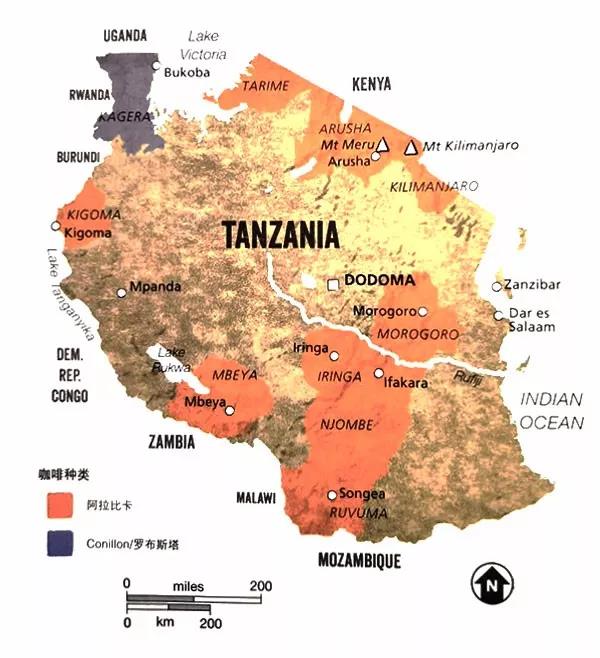
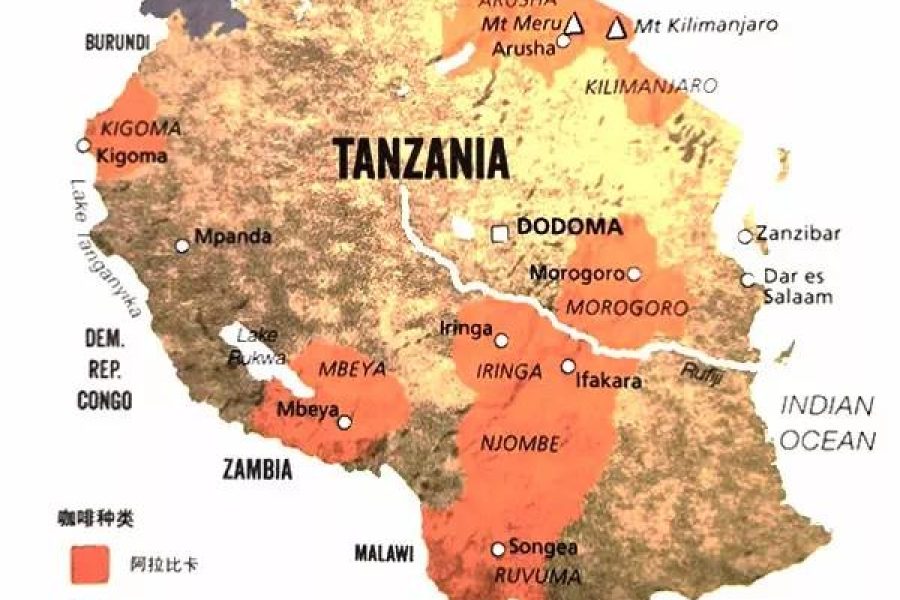
The Kilimanjaro region, Tanzania's oldest Arabica-growing area, sits on the slopes of an active volcano (1,050–2,500 meters above sea level); some coffee trees are over a century old, and low yields give the fruit rich complexity. Coffee from the July–December harvest season, combining Kenyan varieties, Typica, and Typica/Nyara genetics, often presents a full-bodied, wine-like base. The neighboring Arusha region also benefits from volcanic soil but sits at a slightly lower altitude (1,100–1,800 meters), where Bourbon varieties display bright citrus acidity.
The southern Ruvuma region is named after the Ruvuma River; though transportation is inconvenient, it holds hidden surprises—growers around the Mbingo area have long practiced traditional shade cultivation, and the Bourbon-derived N5/N39 varieties (1,200–1,800 meters) often carry blackcurrant and jasmine notes. At the same latitude, the Mbeya region, a multi-crop belt (coffee/tea/cocoa), offers Bourbon and Typica with balanced nutty notes during the June–October harvest season.
In the north, Tarime near the Kenyan border, small-scale Robusta interplantings occasionally burst with distinctive herbal aromas, while the main Arabica varieties (1,500–1,800 meters) suit pour-over brewers seeking a high-body experience. In the northeast, Kigoma is an emerging region whose proximity to Burundi gives its Bourbon and Typica varieties (1,100–1,700 meters) strong value potential.
Based on the characteristics of different regions, the following pour-over recipes are recommended: for Kilimanjaro AA grade, use 92°C water and a 1:15 coffee-to-water ratio, a V60 dripper with a three-pour center-pour extraction (2 minutes total time) to highlight berry and caramel layers; PB grade round beans are better suited to a French press slow brew of 4 minutes to enhance a rounded body. For the southern Ruvuma and Mbeya regions, it is recommended to reduce grind size to medium-fine (70% passing a Chinese standard No. 20 sieve) and use 88–90°C water to avoid the astringency caused by over-extraction.