Arabica vs. Robusta: A Complete Guide to Yunnan Coffee Varieties
Introduction: Want to understand why Yunnan coffee is so highly regarded internationally? This article compares in depth the core differences between small-bean coffee (arabica) and medium-bean coffee (robusta), and analyzes the unique terroir advantages of Yunnan small-bean coffee. From botanical characteristics to flavor profiles, and on to the cultivation secrets of Yunnan's main varieties, it will help you master the key knowledge for choosing high-quality coffee beans.
Small-bean coffee (scientific name: Coffea arabica L.), i.e. the arabica species, is the world's most classic coffee variety, with a cultivation history of more than a century. Before the 15th century, the Arab world monopolized the coffee trade, so Europeans called it "Arabian coffee." This variety accounts for about 75% of global coffee production. Thanks to its layered climate at elevations of 800–1,800 meters, Yunnan produces high-quality small-bean coffee with bright acidity and prominent fruity aromas, which international experts have praised as top quality.
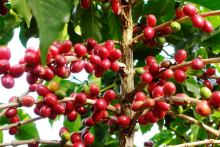
Botanically, small-bean coffee is a small tree, 5–8 meters tall, with ovate-lanceolate leaves (6–14 cm long), flowering in March–April. The fruit is a broad oval berry that turns red when ripe, and the seed has a longitudinal groove. Its optimal growing elevation is 1,200–1,800 meters; too high and it tends to be sour and astringent, too low and the bitterness intensifies. The Typica variety grown in Baoshan and other parts of Yunnan, though less disease-resistant, has rich aromatic complexity, while the Catimor variety, which occupies 95% of the planted area, has strong disease resistance and high yields thanks to its robusta hybrid lineage.
Medium-bean coffee (Coffea canephora), also known as robusta, originated in Africa. The plant is taller (4–8 meters), with thick, papery, broadly elliptical leaves (15–30 cm long). Its berries are nearly spherical, and the seeds have two prominent longitudinal grooves. It adapts to lowland cultivation below 200 meters elevation, is highly disease-resistant but has a rougher flavor, and its caffeine content is more than twice that of arabica. It has been introduced in parts of southern Yunnan and is often used in commercial blends to add body.
When people mention Yunnan coffee, most first think of Pu'er tea, but in fact the province accounts for 70% of China's coffee planting area and 90% of its output. Since a French missionary introduced the first coffee seedling to Zhukula Village in Binchuan County in 1892, a century of development has produced three main varieties: traditional Typica has elegant aromas but requires meticulous management; the Bourbon variety performs excellently at mid-elevations of 1,200–2,000 meters, with rich fruity notes; and the mainstream Catimor, with its rust resistance, has become the first choice for large-scale planting and underpins the Yunnan supply chains of international brands such as Starbucks.
Buying advice: if you prefer floral and fruity notes, choose Typica or Bourbon from elevations above 1,500 meters; for value and everyday drinking, Catimor is a reliable choice. Pay attention to bean density—beans from high-elevation regions are denser and should make a crisp sound when ground, an important indicator of freshness.