Panama Geisha Coffee Grading: Red, Green and Blue Label Flavors and Brewing Tips
Introduction: From Ethiopian wild variety to Panama coffee competition champion, Geisha coffee has become a specialty coffee benchmark thanks to its distinctive floral and fruity aroma. This article takes an in-depth look at Hacienda La Esmeralda's three grades (Red/Green/Blue Label)—their differences in origin, processing methods and flavor profiles—and provides professional pour-over parameter references to help you precisely capture the subtle flavor layers of each Geisha.
In 1931, a wild coffee variety in the Kaffa forests of southern Ethiopia was first documented by researchers as "Geisha"—a name derived from the nearby Geisha Mountain, destined to be linked with extraordinary flavor. After being grown in places such as Kenya and Costa Rica, these coffee seedlings, numbered T2722, finally found their ideal home in Panama in the 1960s.

In the 1990s, Hacienda La Esmeralda owner Daniel Peterson discovered that Geisha plants showed remarkable resistance to the devastating leaf rust. When they managed these coffee trees, planted above 1,600 meters, separately, the 2003 cupping results stunned the industry: bright citrus notes with white florals and a bergamot-like fresh finish. The coffee named "Geisha" won the BOP competition the following year, officially opening a new era for specialty coffee.

Varietal scarcity is the main reason for Geisha's high price: per-tree yield is only half that of ordinary Caturra, and it requires cloud-forest conditions above 1,600 meters with significant day-night temperature swings. Of Panama's annual coffee production of about ten thousand tons, top Geisha accounts for only a tiny fraction; Hacienda La Esmeralda, for example, produces about 9 tons a year, of which only a few hundred kilograms meet the Red Label standard.

Hacienda La Esmeralda divides Geisha into three grades, whose core differences lie in growing altitude, processing method and auction eligibility:
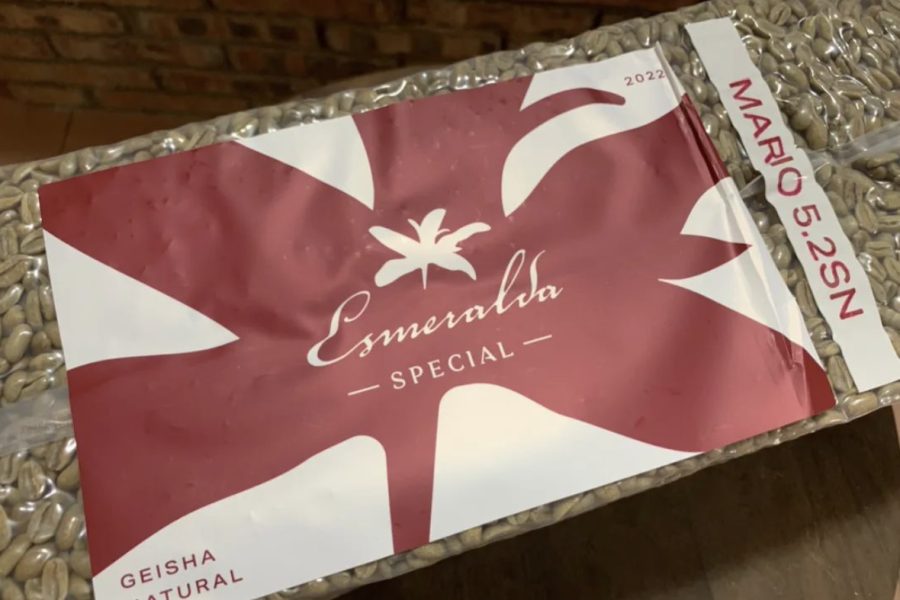
• Red Label Geisha (Esmeralda Special): 1,600–1,800 meters, cupping score 90+, limited to the two core plots Jaramillo and Cañas Verdes, and requires the estate's independent auction (some non-auction lots are of equal quality but lower priced)
• Green Label Geisha (Private Collection): micro-lots from the same altitude blended together, combining output from five sub-plots including Jaramillo, retaining the classic floral-fruity profile but with outstanding value
• Blue Label Geisha (Volcanic Rock): 1,400–1,500 meters, now renamed "Volcanic Rock Geisha," washed processing for a fresher citrus acidity

The five core growing areas each have their own character: Jaramillo (1,600–1,700m) has annual rainfall of 4,000mm and day-night temperature swings of 14°C, and is divided into 5 small plots such as the Reina plot, known for jasmine aroma; Cañas Verdes (1,600–1,800m) has 9 small plots with volcanic-rich soil; the newest El Velo plot (1,700–1,900m) is experimenting with foreign varieties such as Laurina to enhance complexity.

Processing method directly affects the flavor presentation: Red Label is mostly natural, intensifying tropical fruit and honey sweetness (typical flavors: citrus, rose tea, honey); Green Label natural lots balance florals and berry notes (jasmine, melon, berries); Blue Label washed processing highlights fresh acidity (lemon, oolong tea, peach).

Professional brewing suggestions:
• Red Label natural Geisha: 92°C water, V60 dripper at 1:15 coffee-to-water ratio, complete the first pour of 30g within 30 seconds, extend staged extraction to 2 minutes 30 seconds to highlight the floral-fruity layers
• Green Label blend: try a French press, 93°C, steep for 4 minutes to enhance body
• Blue Label washed: lower the water temperature to 90°C and extend pre-infusion by 30 seconds to accentuate the clean acidity

Pay attention to temperature changes when tasting: above 90°C, citrus and florals dominate; after cooling below 70°C, honey sweetness and nutty notes gradually emerge. Store in a sealed, light-proof container, and finish within two weeks of opening to keep the flavor fresh.