Pour-over water temperature: precise control for medium-dark roasts
Introduction: Water temperature is a key variable in pour-over coffee flavor, directly affecting extraction efficiency and taste balance. This article explains the optimal water temperature ranges for coffee beans of different roast levels, provides professional-level temperature control solutions specifically for medium-dark roasted beans, and reveals thermometer selection tips and common misconceptions in actual brewing, helping you precisely adjust parameters and brew coffee with rich layers.
The creation of a quality cup of pour-over coffee hinges on water temperature control—the most easily overlooked yet crucial step. Many beginners believe that as long as boiling water is used, the coffee will turn out well. In reality, a deviation of 1-2°C in water temperature significantly changes the flavor direction—too high a temperature easily leads to excessive extraction of bitter compounds, while too low may result in insufficient extraction of flavor compounds.
The core role of water in coffee: Water, accounting for 94%-98% of the finished liquid, is not just a carrier; its temperature and mineral content directly determine the coffee's sweetness, acidity, and body. When water temperature exceeds 92°C, the release rate of acidic substances (such as citric acid and quinic acid) and aromatic oils in coffee increases exponentially—this is why temperature control is regarded as a fundamental skill for professional baristas.
The general extraction water temperature range recommended by the International Coffee Organization is 90-96°C (195°F-205°F), suitable for most single-origin coffee beans. However, note that boiling state (100°C) should be avoided in practice; continuous boiling causes oxygen loss in the water, making the coffee taste flat. It is recommended to let the water rest for 30 seconds after boiling before starting brewing—by then the temperature usually drops to the ideal range.
For medium-dark roasted coffee beans (City Roast to Full City Roast), special attention to temperature adjustment is needed. These beans, having undergone 15-20 minutes of long roasting, contain more melanoidins produced by the Maillard reaction. If conventional water temperatures (93-95°C) are used, excessive bitter and burnt compounds are easily extracted. Measured data shows that controlling water temperature at 86-89°C (187-192°F) preserves the nutty-chocolate base flavor while avoiding the smoky notes from over-extraction.
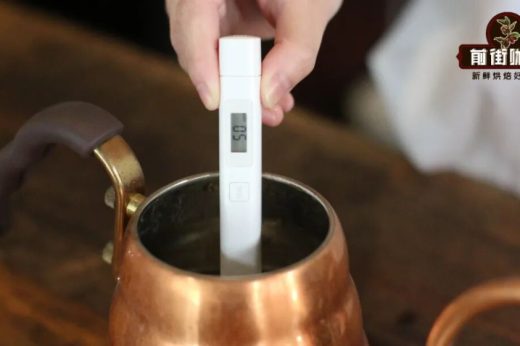
Two details are often overlooked in temperature measurement: first, the measurement point should be the temperature of the mixed liquid in the dripper (not the boiler water temperature); second, it is recommended to use a contact thermometer to measure the water temperature in the first 3 seconds of brewing. Although infrared temperature guns are convenient, they may have a ±3°C error due to environmental reflection, making them more suitable for auxiliary calibration. Professional baristas typically prepare two thermometers for cross-verification.
During actual brewing, precise temperature control can be achieved through the following steps: ① After boiling water, pour it into a preheated server and let it rest for 30-45 seconds; ② Use a thermometer to confirm the mixed liquid temperature reaches the target value; ③ Simultaneously preheat the pour-over kettle and dripper (to reduce heat loss); ④ Monitor water temperature changes every 30 seconds during brewing. Note that the water temperature for dark roasted beans may drop 2-3°C in the latter half of brewing—this is normal.
Common misconceptions to note: avoid using freshly boiled water to directly brew light roasted beans (easily causing sharp acidity), and do not blindly trust fixed temperature values—for every 300 meters increase in altitude, the boiling point of water drops by about 1°C, so high-altitude areas need appropriately increased heat compensation. Once you master water temperature control, you can more confidently adjust other parameters such as coffee-to-water ratio and grind size, systematically optimizing coffee flavor.