ChaPanda's first post-IPO half-year report: net profit down nearly 60%
Introduction: ChaPanda has released its first half-year financial report since listing in Hong Kong, and the data show that both revenue and net profit declined in the first half of 2024, with net profit falling by nearly 60% year on year. This article analyzes in depth the core factors behind ChaPanda's performance changes, including its subsidy policies for franchisees, increased marketing investment, and supply chain dependence, to help readers understand the operational challenges and industry trends behind them.
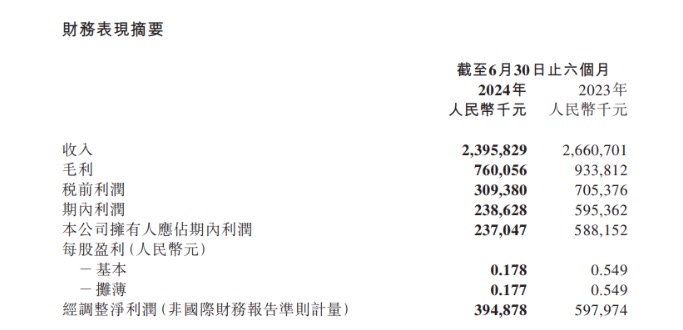
On August 26, 2024, ChaPanda announced its first half-year results report after listing on the Hong Kong Stock Exchange. The report shows that in the first half of 2024 the company achieved total revenue of RMB 2.396 billion, a decrease of about 10.0% compared with RMB 2.661 billion in the same period of 2023. More noteworthy is the net profit performance: net profit in the first half was only RMB 237 million, a sharp drop of 59.7% from RMB 595 million in the same period of 2023. Adjusted net profit was RMB 395 million, corresponding to a net profit margin of 16.5%, also showing a clear downward trend.
Regarding the sharp shrinkage in profit, ChaPanda explained in the report that the main reasons included increased support for franchisees, more favorable purchasing policies for goods and equipment, and increased overall marketing investment. In terms of revenue structure, ChaPanda's revenue mainly relies on two parts: sales of goods and equipment to franchise stores, and royalties and franchise fees collected from franchisees. In the first half of 2024, as much as 95% of revenue came from sales of goods and equipment to franchisees, which shows the extent of its dependence on the franchise system.
To attract more franchisees and reduce their burden of opening stores, ChaPanda launched a series of support measures in its latest franchise policy. For example, at the store signing stage, a new franchisee signing one new store can enjoy a reduction of RMB 40,000; signing two stores brings a total reduction of RMB 180,000. For existing ChaPanda franchisees, each additional store can enjoy a reduction policy of up to RMB 90,000 per store. In addition, ChaPanda shares marketing costs with franchisees through material subsidies; for example, when a new franchisee signs three or more stores, or an existing franchisee signs two or more stores, they can apply for a rebate of 2% to 5% of the annual total material purchase amount. In cities with higher rental costs, such as first-tier, new first-tier and second-tier cities, if store rents reach RMB 600,000, 420,000 and 300,000 respectively, they can also apply for corresponding proportional material rebate support.
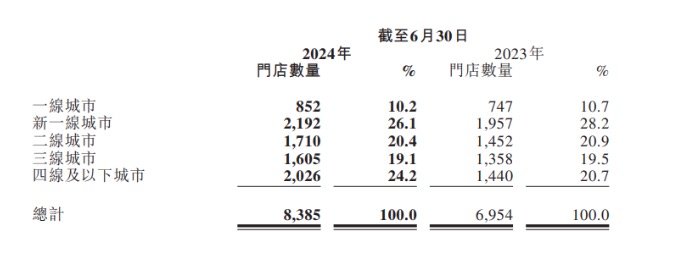
Although the implementation of these preferential policies stimulated continued growth in the number of stores in the short term, it also brought side effects. The report data show that as of June 30, 2024, ChaPanda's total number of stores nationwide had reached 8,385, an increase of 20.6% compared with the same period last year. In terms of city distribution, stores in first-tier, new first-tier, second-tier, and third-tier and lower cities accounted for 10.2%, 26.1%, 20.4% and 43.3% respectively. At present, ChaPanda has only 9 directly operated stores, and the rest are franchise stores. At the same time, the number of franchisees also changed: at the beginning of 2024 it was 5,538, and after half a year 667 were added, but 508 also terminated cooperation, resulting in a final total of 5,697 franchisees at the end of the period.
However, the growth in the number of stores did not bring a corresponding increase in profit. The report reflects that ChaPanda is facing the dilemma of a dual decline in gross profit and net profit. On the one hand, increased franchisee subsidies and material support directly squeezed gross profit space; on the other hand, to expand brand influence, ChaPanda continued to increase investment in marketing and promotion, including social media topic marketing, operation of an official self-media matrix, celebrity endorsements and various brand activities to acquire traffic. Although these measures increased brand exposure in the short term, they further increased the burden of expenses.
In addition to business performance, ChaPanda's performance in the capital market has also been unsatisfactory. Its share price, with market value once as high as about HKD 23 billion at the time of listing early in the year, has now shrunk to less than HKD 10 billion, reflecting investors' concerns about its future growth potential. Analysts believe that in addition to the external environment of intensifying competition in the milk tea industry and somewhat declining consumer demand, ChaPanda's own business model also has shortcomings.
A more prominent problem is that ChaPanda does not have its own production base. Instead, it purchases raw materials (such as dairy products, tea leaves and fruit) from suppliers and then resells them to franchisees at a markup. According to its prospectus disclosed early in the year, ChaPanda has a total of 333 formal suppliers and 124 alternative suppliers. Although this "middleman" model is flexible, its control over the supply chain is far inferior to that of brands with their own factories, such as competitors Heytea and Mixue Bingcheng. Lacking independent production capacity, ChaPanda's procurement costs are more susceptible to market price fluctuations, further squeezing its profit margin.
Looking back at ChaPanda's performance over the past three years, its net profit climbed steadily from 2021 to 2023, rising from RMB 776 million to RMB 1.151 billion, showing strong growth momentum. But the data for the first half of 2024 indicate that its profitability has clearly turned a corner. For future development, how to optimize the supply chain, control costs and improve per-store profitability while maintaining store expansion will be the key issues that ChaPanda's management urgently needs to solve.
Overall, ChaPanda's first half-year report not only reveals the main operational challenges it currently faces, but also provides valuable reference for the franchise model and supply chain management of the entire tea beverage industry. Against the backdrop of increasingly fierce market competition and more rational consumers, brands need to find a more stable balance between expansion and profitability.