Starbucks' new CEO's first letter: focus on store experience and coffee roots

Introduction: After taking office, Starbucks' new CEO Brian Niccol published his first open letter, proposing a 'back to basics' strategy. Facing challenges in North America and China, he emphasized improving the store experience and raising coffee quality, and announced his priorities for the next 100 days. This article details his four core strategies and market response plans, offering brand-transformation insight for coffee professionals and enthusiasts.
On September 9, Starbucks announced that veteran restaurant-industry executive Brian Niccol would take over as CEO. The leader who once turned Chipotle around sent his core message to the public the day after taking office with 'An Open Letter to All Partners, Customers and Stakeholders'—'back to basics'. At the time, Starbucks had just gone through two consecutive quarters of declining performance, especially in the Chinese market, where it faces fierce competition from local brands such as Luckin.
In the open letter, Brian Niccol revealed that over the past few weeks he had gone deep into stores to talk with employees and customers, and had communicated with operations, design and product teams. He observed two key phenomena: Starbucks remains an important part of consumers' daily lives, but the brand has gradually drifted from its original 'coffee at the core' intent. He pointed out that Starbucks should fundamentally be about quality coffee handcrafted by baristas, and that stores are community spaces connecting people, not merely places for transactions.
Starbucks currently shows obvious problems in North America: menus are too complex, drink output is inconsistent, and wait times are too long, all of which degrade the customer experience. These pain points have turned what were once warm coffee interactions into mechanical service processes. To address this, Brian Niccol proposed four directions for improvement: first, ensure baristas have enough time to focus on making each cup of coffee; second, ensure drinks are served on time during peak hours (especially in the morning); third, redefine store functions and optimize spatial layout to distinguish delivery from dine-in needs; and finally, proactively tell the brand story to avoid one-sided outside interpretations.
The North American market will be the first area of reform. Data for the third quarter of 2024 shows Starbucks' North America revenue at US$6.817 billion, up only 1.17% year on year, with operating profit down 2.12% year on year. Brian Niccol revealed that technology investment will be increased, the mobile ordering system upgraded and supply-chain efficiency optimized. For example, pre-ordering through the app will reduce queue times, the menu structure will be adjusted to simplify choices, and the barista training system will be strengthened.
For China, the world's second-largest market, he particularly emphasized the need to 'deeply understand local growth opportunities'. In the third quarter of 2024, Starbucks China revenue was US$734 million, down 10.71% year on year, mainly affected by weak consumption and price wars among local brands. Although the open letter did not detail specific strategies, given industry trends they are expected to involve product localization, upgraded digital operations and optimization of the membership system.
Brian Niccol also announced a first-100-days plan: he will visit stores and support centers and talk directly with baristas and suppliers to drive implementation of the 'back to basics' strategy. This leader, called a 'crisis management expert' by the industry, nearly doubled the company's revenue, grew profit sevenfold and lifted the share price by about 800% during his time at Chipotle. His experience may help Starbucks rebuild the emotional connection between the brand and its customers.
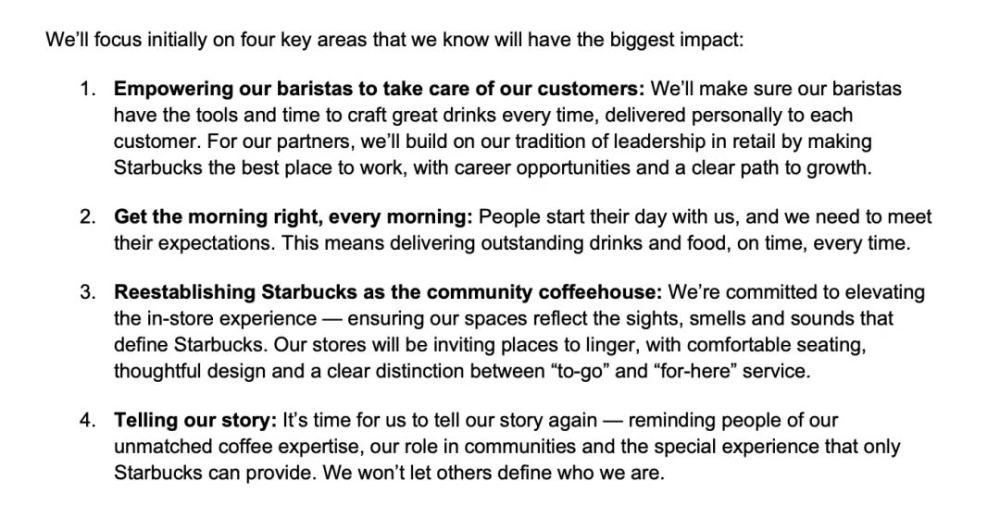
It is worth noting that specific measures to optimize the store experience may include: shortening the standard espresso preparation time to within 25 seconds, adjusting workflow design for peak hours, and clearly defining differences in service flow between dine-in and takeaway areas, among other practical details. For consumers, the future may bring more consistent drink quality, more reasonable queue times and a store environment with a stronger community atmosphere.
From an industry perspective, this strategic adjustment reflects the importance of traditional coffee chains re-examining the 'essential value of coffee' when facing emerging competition. Whether simplifying menus or speeding up service, the core is returning to the relationship between 'people' and 'coffee'. Whether Brian Niccol can lead Starbucks back to its former glory will depend crucially on the next 100 days.