Heytea Internal Letter: Avoiding Homogenization and Price Wars
Introduction: Heytea's latest internal letter to partners has attracted widespread attention, with its core focus on how to respond to fierce competition in the current tea drinks market through a differentiation strategy. This article provides an in-depth analysis of the reasoning behind Heytea's rejection of homogenization and low-price involution, explores the brand's new approaches to product R&D and store expansion, and, combined with consumer feedback, reveals key trends for the future development of the tea drinks industry.
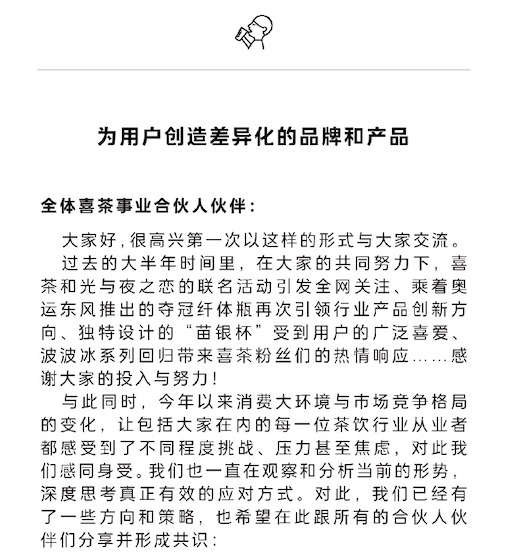
On September 18, Heytea released an internal letter titled "Creating Differentiated Brands and Products for Users" to its business partners, clearly expressing its determination to seek a breakthrough amid fierce competition in the current tea drinks industry. The letter noted that, as the consumption environment changes, competition in the tea drinks market is becoming increasingly intense, and the industry faces new challenges.
In the letter, Heytea mentioned that because growth in consumer demand is not synchronized with growth in overall supply in the tea drinks industry, and in the face of limited consumer demand, the industry has generally chosen convergent product and brand strategies, leading to increasingly fraught homogenized competition. This homogenization is reflected not only in products but also in the convergence of brand strategies, making differentiation between brands increasingly small.
In response to this situation, Heytea's proposed solution is to "create differentiated products and brand experiences for users to the utmost extent", that is, to break out of homogenization and create differentiation. Heytea clearly stated that it will not make homogenized products and will not simply participate in low-price involution. However, regarding how specifically to pursue differentiation, Heytea did not disclose more detailed plans for the time being, only mentioning that it will focus on areas where it excels and where users also have needs.
In the internal letter, Heytea promised to increase investment in both branding and products. On the brand side, this includes brand design and packaging, brand event content, store space, merchandise, and more; on the product side, it will "not follow industry hot categories, and new products will no longer repeat the existing product structure", but will instead explore more differentiated new products and new categories under the direction of healthy tea drinks.
In addition, Heytea also promised not to pursue short-term store opening speed and quantity. In the coming months, it will control store density and pay more attention to opening quality and the operational quality of existing stores. According to public information, as of July 2024, Heytea had more than 4,000 stores worldwide. At the end of 2023, Heytea's store count exceeded 3,200, including more than 2,300 business partner stores. In 2024, it added 1,000 stores, and the pace of expansion has clearly slowed.
The hashtag #HeyteaPartnerInternalLetter# sparked heated discussion among netizens online. Some netizens supported Heytea's decision, believing that adhering to differentiation is the right path for a brand to survive, and worrying that extreme low-price involution will cause brands to lose competitiveness. However, some netizens questioned Heytea's innovation capability, believing that the new products Heytea launched this year lacked novelty, that each quarter's new products were often just simple combinations of seasonal fruit and tea, and that to support the low-price strategy, the quality of the fruit had also declined, losing freshness.
Many netizens pointed out that Heytea's problem lies not only in homogenization but also in the decline in product quality. They believe that Heytea finds it difficult to compete with milk tea brands that use high-quality ingredients, and suggested that Heytea should pay more attention to quality control rather than simply pursuing low prices. Some netizens miss Heytea's early high-quality products and hope that Heytea can return to its previous standards. Some even suggested that Heytea raise product prices to ensure the use of real tea, real ingredients, and real fruit.
It is worth noting that recently Heytea's product prices have again begun to test consumers' bottom line, with the unit price of non-promotional items returning to around 20 yuan. Regarding Heytea's declared anti-involution and anti-price-war stance, some netizens are not optimistic, believing that in the current socioeconomic environment, low-price strategies remain an important means of attracting consumers. They worry that if Heytea's products are expensive without a corresponding improvement in quality, it will be difficult to win back consumers' favor in the fiercely competitive tea drinks market.
Despite facing many challenges, Heytea has demonstrated a clear plan for future development through this internal letter. By focusing on differentiation and brand building, Heytea hopes to find new growth points in fierce market competition. However, whether this strategy can succeed will still depend on Heytea's actual actions in product innovation, quality control, and consumer experience.