Ninji x Detective Conan Collab Backfires: Anime Marketing Pitfalls
Lead: The hand-smashed lemon tea brand Ningji's co-branded campaign with the classic Japanese anime Detective Conan has sparked controversy, with some store posters drawing fan backlash over inappropriate character pairings. This article provides an in-depth reconstruction of the incident, analyzes the dispute over the division of responsibility between the brand and franchisees, and offers a pitfall-avoidance guide for cross-industry anime marketing in the coffee and tea beverage sector.
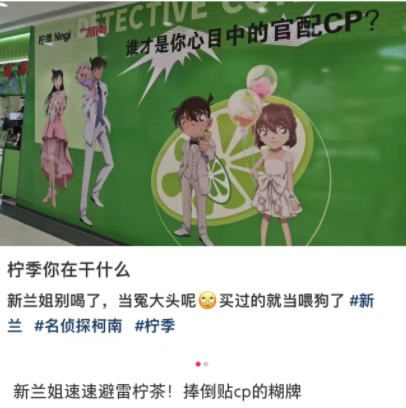
Ningji, a well-known domestic hand-smashed lemon tea brand, recently encountered a serious PR crisis in its co-branded campaign with the Japanese national-level anime IP Detective Conan. According to feedback from multiple consumers, among the themed posters displayed in some partner stores, the protagonist Shinichi Kudo was paired as an "official couple" with Ai Haibara and Ran Mouri respectively, with the leading question "Who is your ideal official couple?" This design quickly triggered strong dissatisfaction among fans of the original work.
The controversy centers on two levels: first, in the original work, Ai Haibara has always maintained a mentor-friend relationship with Shinichi Kudo, and the official side has never acknowledged any romantic connection between the two; second, the act of forcibly pairing the male protagonist with different female characters for a vote has been seen as a marketing tactic deliberately creating "shipping wars." A veteran anime community operator pointed out that such practices not only violate the logic of the original character settings but also undermine the original emotional tension between the characters.
After the incident escalated, the fan community launched a concentrated outcry through social platforms. Some consumers posted photos taken in stores showing that the posters in question used a striking fluorescent background, placed anime screenshots of Conan and Ai Haibara side by side, and included suggestive voting copy below. What sparked even more controversy was that some stores also placed the poster in the main visual area of the storefront, creating a sharp contrast with the official co-branded cup sleeves.
Under public pressure, the Ningji brand issued an official apology statement on October 9. The statement emphasized that the posters in question were produced without authorization by individual franchisees and had violated the content review process agreed upon between the brand and the copyright holder. According to insiders, after discovering the problem, the brand completed an investigation of stores nationwide within 24 hours; in addition to being required to immediately replace the materials, the franchisee involved also faced penalties for breach of contract terms.
However, this explanation failed to calm public questioning. A practitioner in the Japanese IP licensing industry analyzed that in formal cross-border cooperation projects, all offline promotional materials must undergo review by the copyright holder, especially sensitive content involving character relationships. "Judging from the poster design style, it clearly did not go through the Japanese side's review process—professional copyright agencies confirm the presentation of character pairings and wording item by item." Another expert on franchise models pointed out that hoarding posters are usually designed uniformly by brand headquarters, and it is relatively rare for franchisees to independently produce large promotional materials.
This incident is not the first marketing controversy Ningji has encountered. In its "Ningbao Festival" promotional campaign launched in June this year, questions were raised over the unauthorized use of a certain celebrity's name for promotion. At that time, the brand similarly apologized on the grounds of an "internal review oversight" and removed the relevant materials within 48 hours. The two incidents expose a common problem among chain tea beverage brands in the process of rapid expansion: a lack of standardized management in IP cooperation.
For coffee and tea beverage operators planning anime co-branding campaigns, industry experts recommend focusing on three key areas: first, all promotional materials must be confirmed in writing by the copyright holder, especially sensitive elements such as character relationships and classic lines; second, establish a three-tier review system for franchisee materials, with headquarters digitally filing the content displayed in stores; finally, it is advisable to conduct fan community research in advance to avoid content misinterpretation caused by cultural differences. Data shows that among failed co-branding cases between domestic catering brands and Japanese anime IPs in the past three years, 62% stemmed from imperfect content review processes.
The Ningji incident ultimately ended with the brand issuing a public apology and promising to strengthen oversight, but how to find a balance between commercial promotion and respect for IP remains an issue the entire industry needs to keep thinking about. For consumers, while expressing their demands rationally, they can also provide feedback to copyright holders through proper channels, jointly maintaining a healthy entertainment consumption environment.


