Heytea employee added customer on WeChat: protecting privacy in coffee shops
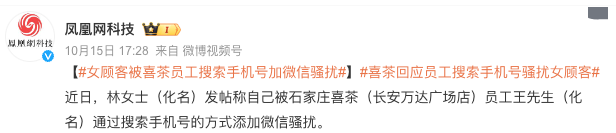
Lead: Recently, an employee at a Heytea store in Shijiazhuang was reported to have used work permissions to privately search for a customer's phone number and add her on WeChat to harass her, triggering widespread public concern about user information protection in the beverage industry. This article reconstructs the events, analyzes how the company involved handled the matter, and, in light of the latest regulations, explains the responsibilities and common loopholes of coffee and tea shops in customer information management.
Recently, a female internet user posted on social media that she had placed an order through the Heytea mini-program at the Shijiazhuang Chang'an Wanda Plaza store, and was subsequently harassed by an employee of that store who added her on WeChat through the phone number search function. According to chat records the customer made public, the employee explained that his action was "a joke with other colleagues at the store," and said "he just picked up the phone, randomly found a phone number and added it."
The woman said she had reported the matter through Heytea's official customer service channel. From the screenshots she provided, the employee's behavior had clearly crossed the line, not only violating professional ethics but also suspected of infringing on personal privacy.
On October 15, the media contacted the Heytea Chang'an Wanda Plaza store involved. The store manager said the incident occurred on the evening of October 14, when the employee was already off duty, and that it was personal behavior. But when asked how the employee obtained the customer's phone number, the manager said only the store's work phone can retrieve customer contact numbers through the order system, and the store was also "not clear" about how the employee specifically got the number.
It is understood that the employee had worked at the store for about half a year, and no similar problems had occurred before. The store manager admitted that although Heytea has internal rules on customer information protection, it had not provided store employees with specialized, systematic privacy protection training. "Because under normal circumstances, normal people wouldn't do such a thing, so we didn't specifically train on this. We never thought someone would actually do it, and we were shocked too."
That afternoon, the woman involved further responded that the matter had now been properly handled: Heytea had dismissed the employee involved, expressed an apology to her, and provided corresponding compensation.

This incident has once again pushed the important issue of "consumer personal information protection" into the public eye. In fact, the Regulations on the Implementation of the Law of the People's Republic of China on the Protection of Consumer Rights and Interests, which came into force on July 1, 2024, set clearer and stricter requirements for business operators' responsibilities in handling personal information.
The Regulations explicitly stipulate that in providing goods or services, business operators must protect consumers' personal information in accordance with the law, must not excessively collect information not directly related to consumption behavior, and must not induce or force consumers to consent to information collection and use through default authorization, blanket authorization, or other means.
Particularly noteworthy is that Article 20 of the Regulations emphasizes consumers' "right to tranquility": without the consumer's own consent, business operators may not send them commercial text messages or make marketing calls, and must also provide consumers with convenient ways to unsubscribe or refuse. These provisions provide consumers with a clear legal basis and support for safeguarding their rights when facing similar harassment.
If a merchant violates the relevant provisions, such as contacting consumers without permission or leaking their information, according to Article 56 of the Law on the Protection of Consumer Rights and Interests, regulators may issue a warning, confiscate illegal gains, and impose a fine of 1 to 10 times the illegal gains; if there are no illegal gains, a fine of up to 500,000 yuan may be imposed. In serious cases, they may even face suspension of business for rectification or revocation of their business license.

As a well-known domestic new tea beverage brand, Heytea has expanded rapidly since it was founded in Jiangmen, Guangdong, in 2012. According to data from industry research firm Frost & Sullivan, Heytea's retail sales reached 9 billion yuan in 2023, ranking fifth among new tea beverage brands.
At the end of 2022, Heytea announced it would open up franchising, and the number of stores grew rapidly. According to its 2023 annual report, by the end of 2023, Heytea had 3,200 stores nationwide, of which more than 2,300 were business partner stores, accounting for over 70 percent. According to statistics from third-party restaurant data platform Zhaimen Canyan, by early August 2024, the number of Heytea stores had further grown to 4,191.
However, this incident also exposes management concerns amid rapid expansion: as the number of stores surges, are frontline employees' operating standards and privacy protection awareness improving in tandem? Have companies established sufficiently rigorous information access permission controls and employee behavior supervision mechanisms? These questions deserve deep thought from every chain consumer brand.