Tims China's 1,000th Store Milestone: How Coffee + Warm Food Breaks Through
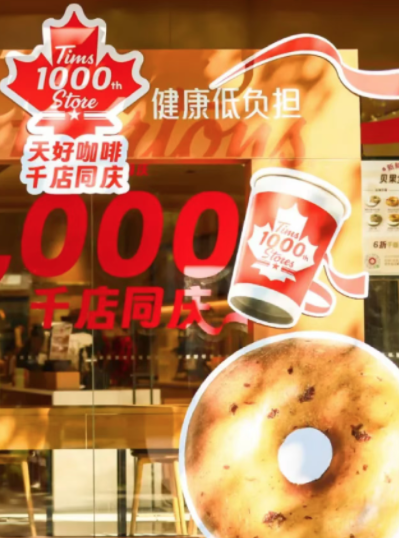
Introduction: In October 2024, Tims China welcomed its 1,000th store in China, landing in Shanghai. From its first store in 2019 to today, how has this Canadian national coffee brand established a firm foothold through differentiation strategies? This article details its core advantage of 'coffee + warm food,' the layout logic of its four store types, and its health-oriented transformation path amid fierce competition, revealing for coffee lovers the operational details behind the brand's 1,000 stores.
On October 25, Tims China's 1,000th store in China officially opened at Huiyin Building, 758 Nanjing West Road, Jing'an District, Shanghai. This chain brand from Canada, relying on its signature combination of 'coffee paired with freshly baked bagels, wraps and other warm food' plus localized menu design, has achieved the leap from its first store to 1,000 stores in just five years.
Looking back to 2019, Tims China began its journey in the Chinese market with its first store at Shanghai People's Square. Through a community-based site selection strategy—for example, embedding stores around office buildings and residential business districts—combined with 'high-value freshly ground coffee + freshly made breakfast,' it quickly built brand awareness. As of June 2024, its business had covered 71 cities nationwide, with cumulative membership exceeding 21.4 million, among which Shanghai had the highest store density in a single city, with more than 200 stores.
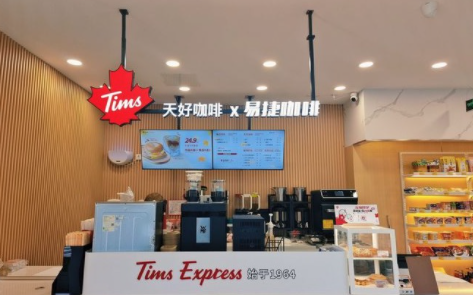
To adapt to diverse consumption scenarios, Tims China planned four main store types: flagship Golden Maple stores (focusing on dine-in experience and brand image display), standard Red Maple stores (regular community/business district stores), Tims Go stores (compact takeaway windows), and Tims Express stores (minimalist self-service mode). Among them, cooperation with supermarkets and gas stations is particularly notable—through shop-in-shop stores co-branded with Metro and quick outlets in Sinopec EasyJoy channels, coffee services are extended to shopping and travel scenarios.
Capital support provides underlying assurance for expansion. Behind the brand are strategic shareholders including Cartesian Capital, RBI International Restaurant Group (which owns brands such as Burger King), and Tencent Investment. After listing on Nasdaq in 2022, the raised funds were mainly used to deepen the store network; in July 2024, the founding shareholders injected another US$65 million for supply chain upgrades and digital investment.
It is worth noting that amid fierce competition in which brands such as Luckin and Cotti add hundreds of stores annually, Tims China's expansion pace is relatively steady: 390 stores at the end of 2021, 227 new stores in 2022, an increase to 285 in 2023, and only a net increase of 4 in the first quarter of 2024. Compared with Starbucks China's annual addition of 885 stores in the same period, its 'laid-back' strategy focuses more on store quality and differentiated competitiveness.
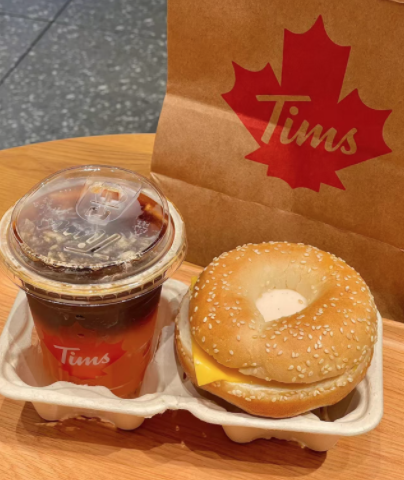
The core anchor of differentiation lies in the golden pairing of 'coffee + warm food.' The product matrix centered on bagels covers demand across multiple time slots such as breakfast and afternoon tea, and in recent years has been further refined into three sub-series—'grain bagels' emphasizing dietary fiber, 'smile bagels' with controlled calories (less than 300 kcal per serving), and high-protein 'bagel burgers' (with meat or cheese filling). In 2024 the brand further optimized its healthy menu, launching a full series of low-calorie bagel sets (total calories <400 kcal), and promised that all beverages contain no non-dairy creamer, coffee creamer, hydrogenated vegetable oil or other ingredients, in line with the current consumer trend of reducing sugar and fat.
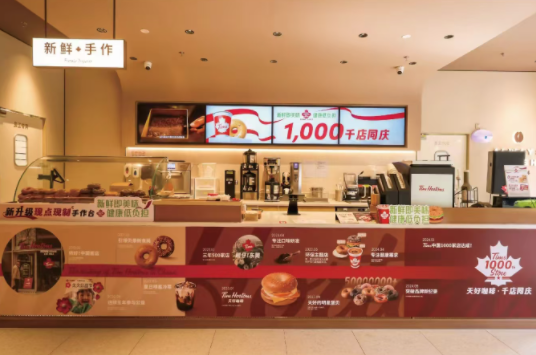
At the unveiling event for the 1,000th store, Tims China CEO Lu Yongchen clearly proposed a new brand proposition: 'Fresh is delicious, healthy and low burden.' This direction both responds to consumers' demand for ingredient transparency and functionality and provides a clear path for the brand to find growth in a stock market.