Arabica vs. Robusta coffee beans: flavor differences and a selection guide
Introduction: Coffee enthusiasts often face the dilemma of choosing between Arabica and Robusta. This article takes an in-depth look at the core differences between the two major coffee species, from caffeine content and flavor characteristics to growing environment requirements, combining professional parameters with practical tasting experience to help you understand why specialty coffee generally favors Arabica, and includes a practical flavor guide to representative varieties from producing regions.
The coffee beans circulating in the global coffee market are mainly divided into two major categories, Arabica and Robusta, but there is a significant difference in market acceptance between the two. Data shows that over 80% of the specialty coffee sector chooses Arabica beans, while Robusta appears more often in instant coffee or espresso blends. Behind this preference are the essential differences between the two in chemical composition, growing conditions and flavor performance.
From a chemical composition perspective, Arabica's caffeine content is only 0.9%-1.2%, about 30%-50% lower than Robusta; its fat content is 60% higher than the latter, and its sugar content is twice as much. These differences are directly reflected in the taste—Arabica, due to its low caffeine and high sugar-fat ratio, presents obvious sweetness, soft acidity and fruity notes; while Robusta, due to its high caffeine (1.7%-2.7%), high chlorogenic acid and complex amino acid combination, often carries a nutty, grainy full-bodied feel, with some batches even showing stimulating flavors such as earthy notes.

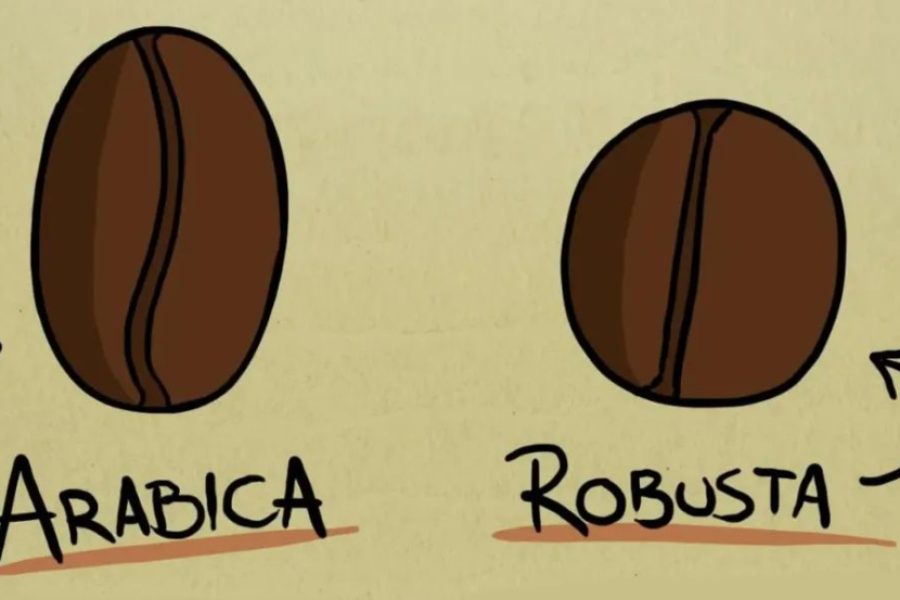
Differences in adaptability to the growing environment further widen the gap between the two. Arabica requires a high-mountain environment at 1,000-2,000 meters above sea level; low temperatures and slow ripening allow its fruit to fully accumulate sugar, but it is susceptible to pest damage and requires careful manual management (for example, manual picking costs 3-5 times more per kilogram than Robusta); Robusta, on the other hand, can grow in lowlands at 200-800 meters above sea level, has strong disease resistance (relying on the natural insect-repellent effect of high caffeine and chlorogenic acid), but its flavor layers are relatively one-dimensional. It is worth noting that changes in bean shape after roasting can interfere with variety identification—at the green bean stage, Arabica is slender and oval with an "S"-shaped center line, while Robusta is rounder with a center line close to straight, but this feature becomes blurred after roasting due to bean expansion.
In terms of flavor performance, Arabica's diversity is remarkable. The microclimates of different producing regions (such as Ethiopia's highland rainforests and Colombia's volcanic soil) give it a unique imprint: medium-light roasting releases bright fruit acidity such as citrus and berries, while dark roasting highlights warm-toned flavors such as caramel and chocolate, with lively acidity and a clean finish. Robusta focuses on full-bodiedness and is often used in espresso blends to enhance crema thickness (typical addition ratio 5%-15%, in extreme cases up to 25%); its low acidity, strong bitterness and woody texture suit pairing with milk to balance the taste, but drinking it alone tends to seem rough.

Botanical characteristics also visually distinguish the two: Arabica coffee tree leaves are slender ovals (about 10-15 cm long), and the plant height is 2-3 meters; Robusta leaves are broad and thick (often over 15 cm long), and the tree can reach over 10 meters. In terms of coffee bean morphology, Arabica beans are long and flat (standard size 17-19 screen), while Robusta is closer to round (generally 14-16 screen). In addition, Arabica, as the core branch of the coffee family, has cultivated nearly 3,000 varieties (such as Typica, Bourbon and their derivatives), all originating from ancient native varieties of Ethiopia; Robusta variants are relatively limited.
Taking typical producing regions as examples: Jamaica Blue Mountain's Typica (an ancient Arabica branch) has significantly improved resistance to leaf rust due to domestication in the island climate, and after medium-dark roasting presents chocolate and nutty aromas, with soft acidity and outstanding sweetness; Panama Hacienda La Esmeralda's Geisha (a Typica derivative) requires a misty environment at over 1,500 meters above sea level; low leaf photosynthetic efficiency leads to extremely low yields (annual output per tree is less than 1/3 of ordinary varieties), yet in exchange it delivers a complex floral aroma of rose, citrus and berries, and its Red Label batches are frequent guests at specialty coffee competitions. Ethiopia's "Heirloom" covers thousands of unnamed wild variants; for example, Yirgacheffe's small beans often carry jasmine and lemon notes, making them a treasure trove of flavor exploration for pour-over enthusiasts.