Colombian Coffee Regions: Flavor Profiles and Pour-Over Guide
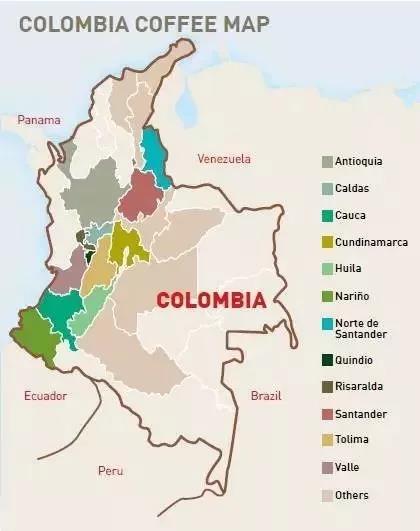
Introduction: Want to know which classic coffee regions Colombia has? How do their flavors differ, and are they on the acidic side? This article takes you deep into Colombia's main coffee regions, explains how altitude and climate affect flavor, and breaks down the characteristics of mainstream coffee varieties, helping you find the beans that best suit your taste—whether for everyday drinking or pour-over brewing, you'll be able to choose more precisely.
As the world's third-largest coffee exporter, Colombia is known worldwide for its high-quality Arabica coffee. Its coffee cultivation is mainly concentrated in the Andean region, where mineral-rich volcanic soil and suitable altitudes provide an ideal growing environment for coffee. It is said that coffee was introduced to Colombia in 1730 by Venezuelan missionaries and was first planted in the southeast, later gradually spreading to the western mountains. Thanks to the high altitude and stable climate, coffee here usually must be hand-picked only after the fruit is fully ripe, ensuring rich flavor and consistent quality.
In promoting the development of the coffee industry, the Colombian Coffee Growers Federation (FNC) has played a vital role. The organization is not only dedicated to promotion in the global market but also serves as a solid backer for Colombian coffee farmers, promising to buy farmers' coffee regardless of volume, while also providing domestic technical support and resource guarantees to ensure the sustainable development of coffee cultivation.
Colombian coffee flavors are extremely diverse, ranging from mellow chocolate notes to fresh fruit aromas and sweetness. Different regions, due to differences in altitude, microclimate and soil, present entirely different expressions in the cup. Overall, coffee here often has bright but not sharp acidity, prominent sweetness, and rich layers, making it very suitable for pour-over enthusiasts seeking flavor balance.
In terms of regions, Colombian coffee has two harvests a year, with slight differences in harvest periods across areas. The following are several representative important regions and their characteristics:
Cauca is one of the most representative high-altitude regions, with an average altitude of about 1,758 meters and a maximum of 2,100 meters. The terrain is steep, rainfall and temperature are moderate, and together with fertile volcanic soil, this provides excellent growing conditions for coffee. The dry season is concentrated in August and September, followed by the rainy season, which prompts dense flowering and the harvest season. Significant day-night temperature differences (about 18°C during the day and about 11°C at night) allow coffee fruit to ripen slowly, which helps accumulate flavor compounds, so Cauca coffee generally has bright acidity and prominent sweetness. Common varieties include Typica, Caturra and Castillo.
Valle del Cauca, although once an area with frequent armed conflict, has extremely fertile soil and is an important coffee region. The growing altitude ranges from 1,450 to 2,000 meters, the main harvest season is from September to December, and the secondary harvest season is from March to June. The main varieties grown are likewise Caturra, Typica and Castillo.
Tolima is dominated by smallholder farming. Many coffee farmers process fresh fruit centrally through cooperatives, while some choose to process it themselves. The region's altitude ranges from 1,200 to 1,900 meters, the main harvest season is from March to June, and the secondary harvest season is from October to December. Varieties grown include Caturra, Typica and Castillo. Because much of it is small-scale, meticulous cultivation, Tolima coffee often has a uniquely delicate flavor.
Huila is known as Colombia's most famous specialty coffee region, surrounded by mountains, generally above 1,500 meters in altitude, and located at the confluence of important rivers, with abundant water resources. Coffee from this area has a full body and complex layers, with rich fruit aromas. The harvest period is from September to December (main season) and April to May (secondary season), and the varieties grown are roughly the same as those in the above regions.
Quindío is home to the National Coffee Park and hosts a grand coffee-themed event every year, attracting many coffee lovers. The region's altitude is 1,400–2,000 meters, the harvest period is similar to Huila's, and the flavor expression is also similar.
The Risaralda region has an altitude of 1,300 to 1,650 meters and is likewise dominated by Caturra, Typica and Castillo. The harvest seasons are concentrated in September to December and April to May, and the coffee style is fresh and pleasant.
Nariño, in the southwest, is one of Colombia's highest coffee regions, with an altitude range of 1,500 to 2,300 meters, so its harvest period is slightly later, mainly April to June. The high altitude gives it distinct acidity and complex flavors, making it highly favored by the specialty coffee market.
Caldas has a research base operated by NFC (National Coffee Research Center) and is an important center for coffee technology research. The region's altitude is 1,300 to 1,800 meters, and the coffee harvest period is September to December and April to May. Variety selection is still mainly Caturra, Typica and Castillo, which are suited to the high-altitude environment.
Antioquia is the province with the largest coffee planting area in Colombia, with 128,000 hectares planted and output accounting for 18% of the country's total, second only to Huila. Its altitude is 1,300 to 2,200 meters, and the harvest period is September to December and April to May. It is an important source of stable supply of high-quality coffee.
Cundinamarca is home to the capital, Bogotá, the highest-altitude capital in the world. The region's altitude is between 1,400 and 1,800 meters, and the coffee harvest period is concentrated in March to June and October to December. Varieties are likewise mainly Caturra, Typica and Castillo.
Finally, Santander/North of Santander is located in northern Colombia. The coffee style tends toward roundness and sweetness, with a growing altitude of 1,200 to 1,800 meters and a harvest period from September to December, suitable for coffee lovers who prefer a milder taste.
In summary, the reason Colombian coffee is widely popular around the world is inseparable from its diverse regions, rigorous cultivation management and outstanding flavor expression. Whether you are a beginner coffee lover or a pour-over player pursuing the ultimate flavor, you can find a Colombian coffee bean that suits your taste.