Bolivia Coffee Flavor Profile: High-Altitude Micro-Lots and Scarcity Behind the Death Road
Introduction: Although Bolivian coffee is scarce in volume and difficult to transport, high-altitude cultivation and unique terroir produce specialty beans with a standout clean sweetness. This article explains the characteristics of its heirloom varieties, the harvesting context of the perilous 'Death Road' in the Yungas region, and the flavor differences among producing regions, helping you understand why coffee from this South American land is precious and worth exploring.
Among the many coffee-producing countries in South America, Bolivia's presence has always been modest. This country, whose economy relies mainly on minerals and natural gas, has limited agricultural scale, and coffee cultivation makes up only a small part of it. More difficult still, many local farmers prefer to grow coca leaves—a crop with relatively stable prices that offers them a more reliable livelihood. Although Bolivia has natural advantages for coffee growing—high altitude and distinct dry and wet seasons—weak infrastructure and poverty have consistently constrained coffee processing, transportation, and quality improvement.
To improve the situation, the United States once helped Bolivia establish small coffee wet-processing plants, and the local coffee industry has also worked to raise quality. However, compared with neighboring Colombia and Brazil, Bolivian coffee still lags in international recognition. Coffee production here is dominated by smallholder systems, with about 23,000 coffee-growing families nationwide, small in scale and scattered. The varieties grown are mostly old heirloom types such as Typica and Caturra; though less popular than some newer varieties, these have unique regional flavor potential.
High-quality Bolivian coffee usually shows a sweet and clean profile; fruit notes are not prominent, but cleanliness and sweetness are its notable characteristics. It is worth mentioning that Bolivia's diverse terrain is hailed as ideal for specialty coffee micro-lots, with different microclimates and altitude conditions giving the coffee rich layers of complexity.
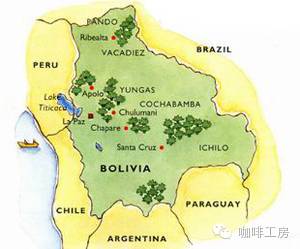
Bolivia's coffee regions are concentrated in three areas, of which Yungas is the most important core region, contributing about 95% of the country's coffee production. Covered by dense forest, it has rare high-altitude coffee-growing conditions and is also Bolivia's oldest coffee region. The most famous sub-region of Yungas is La Paz, located in western Yungas, but the road there is extremely treacherous—the famous 'Death Road' (Yongas Road). It is a one-lane road, winding and steep, with almost no guardrails along its entire length; vehicles can plunge into a 600-meter-deep valley at any moment, which is why it is called 'the world's most dangerous road.' Coffee buyers who want to visit producers directly must pass along this terrifying road. The Yungas region covers several sub-areas, such as Caranavi and Inquisivi, at altitudes ranging from 800 to 2,300 meters, with the best harvest period from July to November each year.
Another region, Santa Cruz, is located in the far east of Bolivia, with generally lower altitude, about 410 meters, so high-quality coffee is relatively rare. Although coffee is grown here, limited by altitude and climate conditions, the flavor complexity and sweetness are usually inferior to the Yungas region; the harvest period is likewise July to November.
Finally, the BENI region, located in northeastern Bolivia, is vast and sparsely populated, with some areas forming a geographic extension of Yungas. At an altitude of only 155 meters, it likewise faces limited coffee quality; the harvest period is consistent with other main regions, between July and November.
Overall, the preciousness of Bolivian coffee stems not only from the unique flavors brought by high-altitude cultivation but also from the difficult production and transportation environment behind it. For coffee lovers, trying a cup of Bolivian micro-lot coffee from the Yungas region offers not only a clean sweetness and complex layers but also the story of every bean traveling the perilous 'Death Road' to reach the cup.