Costa Rica Coffee Guide: Six Regions, Flavors and Growing Altitudes
Introduction: From its first exports in 1820 to today, Costa Rican coffee has become a major player in the global specialty coffee market thanks to its consistent quality and distinctive flavors. This article takes you deep into the country's seven core regions—their geography and best harvest periods—and the bright acidity and layered mouthfeel brought by varieties such as Caturra and Bourbon, helping you choose the right beans for pour-over or espresso.
Costa Rica's coffee-growing history began in the early 19th century, when seedlings were first introduced from Cuba. A small amount of coffee was exported to Panama in 1820, but large-scale international trade truly began in 1832—these beans had to pass through Chile before reaching the English market. Over two centuries of development, the country has built one of the world's most complete coffee production and distribution systems, with strict standards applied from cultivation and processing to grading and export, ensuring a high degree of consistency in coffee quality.
The soul of the country's coffee flavor comes from its diverse microclimates and high-altitude growing environments. The main cultivated varieties include Caturra, Typica, Catuai, Bourbon and the highly sought-after Gesha in recent years. Under different altitudes and soil conditions, these varieties produce beans that combine pure fruit aromas with a full-bodied mouthfeel; the overall flavor profile leans toward bright citrus notes and soft sweetness, with lively but not sharp acidity.
The country is divided into seven coffee regions with distinct characteristics, each forming a unique flavor profile due to differences in geography:
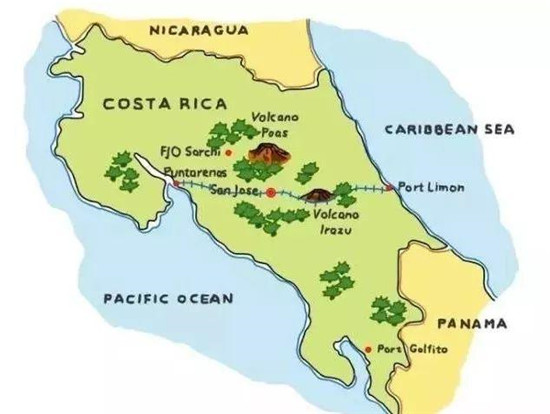
Valle Central, the core region, contains three active volcanoes. Volcanic ash soils and altitudes of 900-1600 meters produce coffee with excellent balance. The region has many sub-regions, and its best harvest period is from November to March; medium body and a black-tea-like finish are common.
West Valley is divided into six sub-regions, where distinctive varieties such as Villa Sarchi have taken root. Altitudes of 700-1600 meters and a harvest window from October to February give its coffee a characteristic nutty and caramel aroma.
The highest-altitude region, Terrazu, is known for high-quality coffee. Growing altitudes of 1200-1900 meters combined with a harvest period from November to March mean the coffee usually shows complex berry flavors and a silky mouthfeel.
Tres Rios, east of San Jose, is a small region but produces refined coffee thanks to volcanic soil. Altitudes of 1200-1650 meters and a harvest rhythm from November to March give it clear citric acidity and honey sweetness.
Orosi, with a century of growing history, sits in a narrow river valley. Altitudes of 1000-1400 meters and an exceptionally long harvest period from August to February give its coffee soft peach flavors and lower acidity.
Brunca developed thanks to growing techniques brought by Italian immigrants after World War II. Altitudes spanning 600-1700 meters and a harvest period from November to February mean the predominant Caturra and Catuai varieties often present a blend of chocolate and tropical fruit aromas.
The humid Turrialba region faces multiple challenges. Altitudes of 500-1400 meters and a long harvest season from July to March cause coffee trees to flower multiple times, and only a few plots produce high-quality coffee with a complete structure.
Finally, Guanacaste is mainly low-altitude cultivation. The 600-1300 meter range and a harvest period from July to February make specialty coffee relatively scarce in this region, which is better suited to everyday drinking with good value for money.